Ceramic Coating: Complete Guide, Cost, Benefits & Is It Worth It?
You paid over $1,200 for a ceramic coating. Three weeks later, the automated car wash left a swirl mark right across the hood.
Frustrating? Absolutely. But the problem wasn’t the coating. It was the expectation.
Ceramic coating for cars is one of the most powerful forms of ceramic paint protection available today. It’s also one of the most misunderstood products in auto care.
This guide cuts through the marketing noise. You’ll learn exactly what it is, what it actually protects against, how much it costs in 2026, and – most importantly, whether it’s right for your car.
No hype. Just honest answers.
Is Ceramic Coating Worth It?
Yes – for most car owners, auto ceramic coating is absolutely worth it. It delivers long-term paint protection, a deeper gloss, and a surface that stays cleaner between washes. But only when the prep work is done right and your expectations match reality.
Here is what you need to know upfront.
⚠️ 3 Things Ceramic Coating Is NOT
❌ NOT Scratch-Proof
It resists light swirl marks and fine surface scuffs. Deep scratches, rock chips, and key marks will still cut straight through it.
❌ NOT Permanent
Most professional automotive ceramic coatings last between two and seven years. Environmental exposure, harsh chemicals, and improper washing all shorten that lifespan.
❌ NOT Maintenance-Free
You still need to wash your car regularly. The coating just makes washing faster and easier.
On cost: A professional application typically runs between $700 and $2,500, depending on your vehicle size and the installer. Quality DIY kits start around $30-150, though proper prep materials can push your total closer to $250. The ceramic coating price gap between DIY and professional is real – and later in this guide we break down exactly what drives that difference.
Bottom line: If you own a newer car, drive it regularly, and want to protect its paint and resale value for years – ceramic coating delivers strong, measurable value. If you are expecting a magic shield that eliminates all maintenance, you will be disappointed.
What Is Ceramic Coating?
Most car owners have heard the term. Far fewer understand what it actually does.
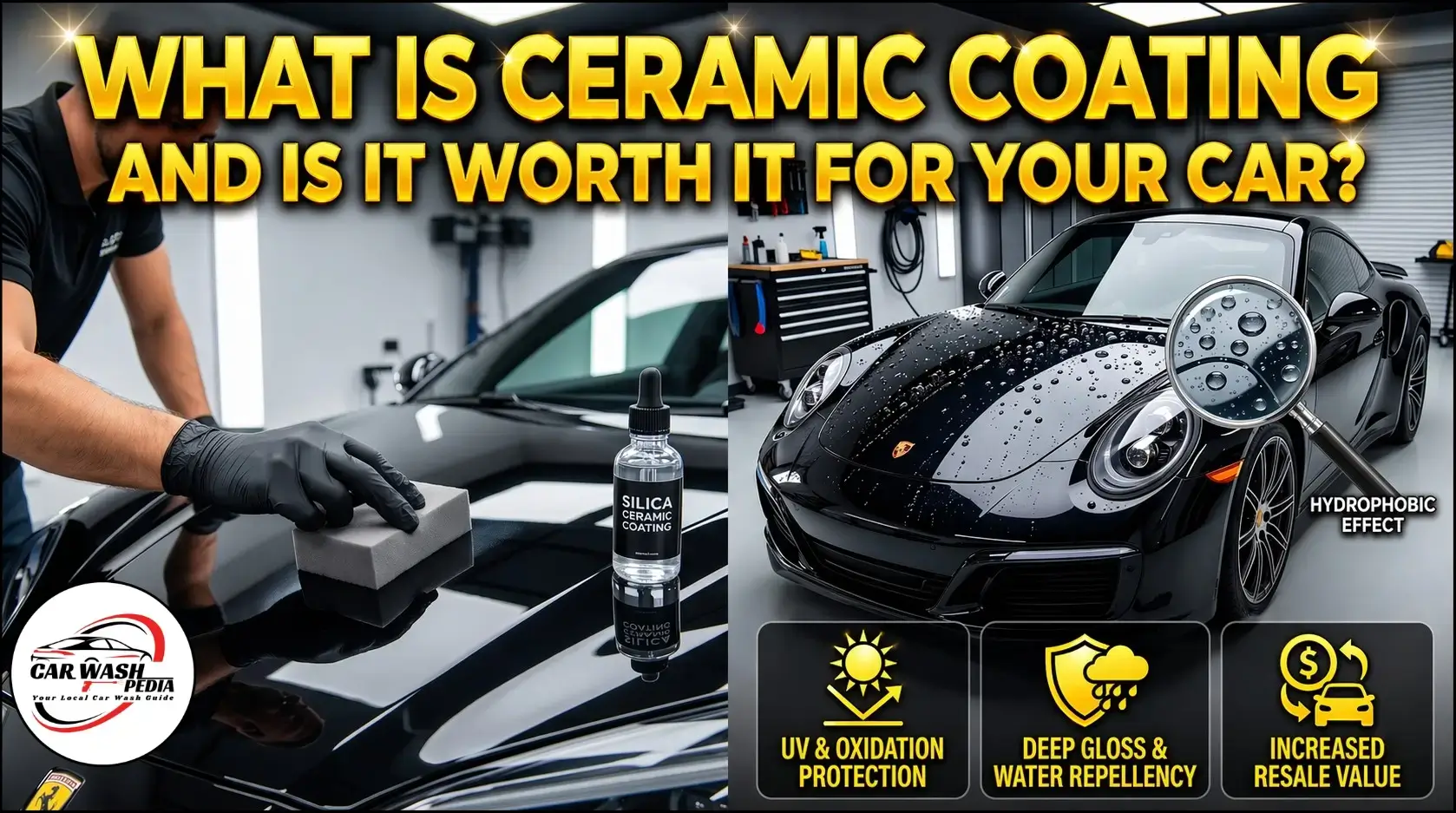
Ceramic coating for cars is a liquid polymer applied by hand to your car’s exterior surfaces. Once it cures, it chemically bonds directly to the clear coat. It does not sit on top of the paint like a traditional wax or sealant. It fuses with the surface at a molecular level and becomes part of it.
Think of it this way. Wax is like a raincoat thrown over your paint. Ceramic coating on paint is like a second skin that bonds to it permanently – until it eventually wears away years later.
The result is an ultra-thin, ultra-hard, glass-like layer sitting over your factory clear coat. That layer is what gives a ceramic coated car its deep gloss, its water-beading behavior, and its resistance to UV rays, chemicals, and light scratches.
One important clarification: once fully cured, nano ceramic coating becomes semi-permanent. It will not wash off, wipe off, or peel like wax. But “semi-permanent” is not the same as forever. It degrades gradually over years – faster if you skip maintenance or use the wrong wash products.
What Is Ceramic Coating Made Of?
The active ingredient in most nano ceramic products is silicon dioxide (SiO2), a compound also found in glass and quartz. Some formulations use titanium dioxide (TiO2) or a blend of both for added hardness and UV resistance.
The SiO2 concentration percentage matters more than most buyers realize. A consumer-grade nano coating for car use might contain 50-70% SiO2. Professional-grade coatings typically run 80-93%. Higher concentration means a harder, more durable cured layer – and a narrower margin for error during application.
This is why the term ceramic paint coating gets used loosely in marketing. Some spray-on “ceramic waxes” contain only a trace amount of SiO2. They are not true ceramic coatings. They do not chemically bond and they do not last. We cover that distinction in the comparison section.
A quick word on hardness ratings. You will often see ceramic coating 9H listed as a product feature. This refers to the pencil hardness scale – 9H being the hardest. A 9H ceramic pro grade coating resists surface marring and fine scratches better than lower-rated products. It is a useful benchmark, though not an absolute guarantee of scratch immunity.
What about graphene? Graphene coatings are the next evolution beyond SiO2-based ceramics. They add graphene particles to the formula, which improves heat dissipation, reduces water spotting, and can extend coating life. They are newer, pricier, and not yet as widely available. We will cover graphene vs ceramic in a dedicated comparison – but for most car owners right now, a quality SiO2 ceramic remains the proven choice.
How Does Ceramic Coating Work on Car Paint?
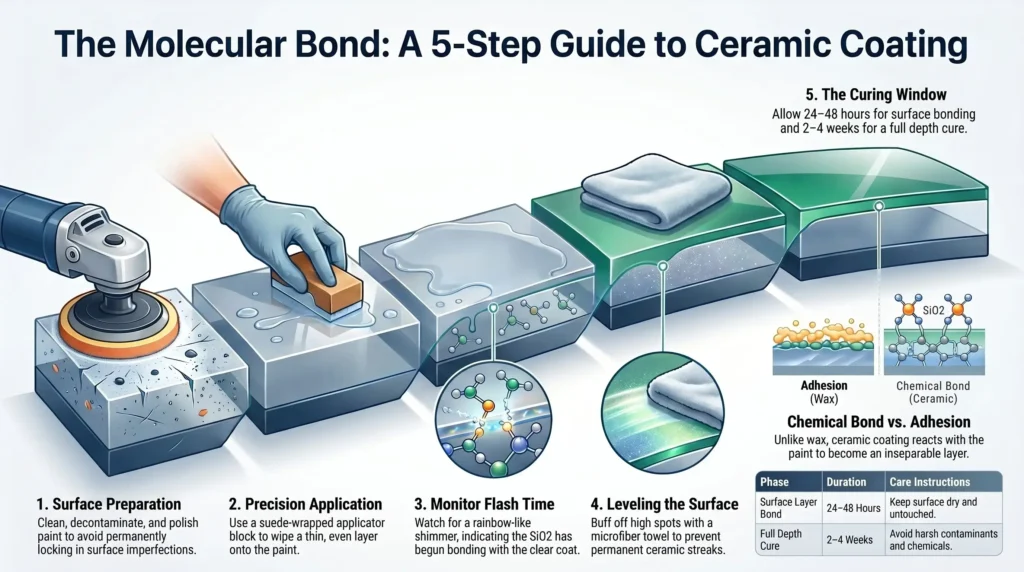
Here is exactly what happens from application to full cure – in plain terms.
Step 1: Surface Prep. The paint must be clean, decontaminated, and polished before coating a car. Any imperfections present at this stage get locked in permanently. This is the step most people skip – and the one that causes the most regret.
Step 2: Application. The liquid car coating is applied in small sections using a specialized applicator block wrapped in suede. A thin, even layer is wiped onto the paint surface.
Step 3: Flash Time. Within seconds to minutes (depending on temperature and humidity), the coating begins to “flash.” You will see a rainbow-like shimmer appear. This is the SiO2 starting to bond with the clear coat.
Step 4: Leveling. Before it hardens, the installer buffs off the high spots using a clean microfiber towel. Timing here is critical. Too early and you remove the coating. Too late and it cures unevenly, leaving high spots called “ceramic streaks” – a frustrating and costly mistake to fix.
Step 5: Cure. Full chemical bonding takes 24-48 hours for the surface layer. Full depth cure typically takes 2-4 weeks. During this window, the car should stay dry and away from harsh contaminants.
The key difference from wax: Wax fills microscopic pores in the clear coat and sits on top. It bonds through adhesion only. Ceramic coating chemically reacts with the clear coat itself. Once cured, you cannot simply wash it off – because it is no longer a separate layer. It is part of the paint surface.
What Does Ceramic Coating Actually Protect Against?
This is where most buyers get misled – usually by detailers who oversell and marketers who overpromise.
Automotive ceramic coating creates a genuine, measurable barrier between your paint and the outside world. But that barrier has clear limits. Knowing both sides protects you from disappointment and wasted money.
Here is exactly what a quality car paint protection coating will and will not defend against.
✅ What Ceramic Coating Protects Against
- UV rays and paint oxidation: Direct sunlight breaks down your car’s clear coat over time. Paint fades, oxidizes, and loses depth. A protective coating for cars with strong SiO2 concentration blocks UV penetration and significantly slows this process. Dark colors – especially black and deep blue – benefit most visibly from this protection.
- Chemical etching from bird droppings, tree sap, and acid rain: These are among the most damaging contaminants your paint faces. They are acidic. Left on bare paint, they etch permanently into the clear coat within hours on a hot day. The ceramic protection for car surfaces creates a sacrificial chemical barrier that takes the etching damage first – buying you time to clean it off safely.
- Water spots and mineral deposits: Hard water leaves calcium and mineral deposits that bond to bare paint and become increasingly difficult to remove. The hydrophobic coating car surface causes water to bead up and roll off before it can dry and leave deposits behind. This is the benefit most car owners notice first – and the one that genuinely reduces washing effort.
- Light swirl marks from washing: The hardened coating nano layer adds measurable surface hardness above your clear coat. It does not prevent swirl marks entirely. But it resists the fine scratches caused by improper washing technique, dirty wash mitts, and automatic brush car washes better than bare paint or wax ever could.
- Dirt, road grime, brake dust, and general contamination: This is the practical daily-driving benefit most people underestimate. Contaminants simply do not stick to a ceramic surface the way they stick to bare paint. Road grime wipes off with less effort. Brake dust on wheels rinses away faster. Auto coating protection genuinely reduces the time and labor of every wash you do from this point forward.
❌ What Ceramic Coating Does NOT Protect Against
- Deep scratches and rock chips: A ceramic coat adds hardness – but it is measured in microns. A stone chip traveling at highway speed hits with enough force to cut straight through the coating, the clear coat, the base coat, and sometimes the primer. For this level of physical impact protection, Paint Protection Film (PPF) is the correct solution – not ceramic coating. These are two different products built for two different jobs.
- Dents, dings, and physical impact damage: No surface coating of any kind prevents physical deformation. Ceramic is not structural. A shopping cart, a hailstone, or a door opened too hard will dent a ceramic coated car just as easily as an uncoated one.
- The need for regular washing: This myth costs detailers repeat business and costs car owners their coating’s lifespan. A ceramic coated car still collects dirt, pollen, bird droppings, and road film. It simply releases them more easily when you do wash. Skipping washes for months allows contaminants to build up and eventually degrade even the strongest ceramic coating for glass surfaces and painted panels alike.
💡 Remember this: Ceramic coating makes your car easier to clean – it does not make it self-cleaning.
Ceramic coating makes your car easier to clean – it does not make it self-cleaning.
Ceramic Coating on Glass and Other Surfaces
Most guides focus only on paint. But quality ceramic coating on glass – including your windshield and side windows – delivers real functional benefits beyond appearance.
Ceramic coating windshield application causes rain to bead and sheet off at speed, improving visibility in wet conditions without relying entirely on your wipers. Many drivers report needing wipers far less frequently above 45 mph after ceramic windshield coating treatment.
Ceramic coating on windshield surfaces also resists the micro-pitting caused by sand, grit, and road debris that gradually clouds uncoated glass over time.
The same logic applies to wheels, plastic trim, and exhaust tips. Glass coating car surfaces – including sunroofs and mirrors – benefit from the same hydrophobic and chemical-resistance properties as the painted body panels.
When booking a professional application, always ask whether the quoted price includes glass and trim surfaces – or whether those are charged separately.
Ceramic Coating vs Car Wax vs Paint Sealant vs PPF: Which One You Need?
Before spending a dollar on paint protection, understand what each product does – and does not do.
These four options are not interchangeable. They sit at completely different price points, deliver different levels of protection, and suit different types of car owners. Here is a direct, side-by-side breakdown.
Ceramic Coating vs Car Wax vs Paint Sealant vs PPF – Full Comparison
| Feature | Car Wax | Paint Sealant | Ceramic Coating | PPF |
|---|---|---|---|---|
| Durability | 1-3 months | 6-12 months | 2-7 years | 5-10 years |
| Scratch protection | None | Minimal | Minor swirls only | Strong – rock chips, abrasion |
| UV protection | Basic | Moderate | Strong | Strong |
| Hydrophobic effect | Slight | Moderate | Strong | Moderate |
| Chemical resistance | Low | Moderate | High | High |
| Cost (approx.) | $20-$80 | $50-$200 | $300-$2,500 | $1,500-$7,000+ |
| DIY friendly | Yes | Yes | Possible | No |
| Maintenance required | Re-apply every 1-3 months | Re-apply every 6-12 months | Wash regularly + booster spray | Professional inspection yearly |
| Best for | Budget-conscious / casual | Seasonal protection | Daily drivers, long-term value | New cars, luxury, daily rock chip exposure |
Now, we will break down each option in somewhat detail to understand the concept and scope of each option.
1. Car Wax – The Entry-Level Choice
Traditional car ceramic wax products and natural carnauba waxes are the most accessible form of paint protection. They are easy to apply, forgiving for beginners, and affordable. Products like Meguiar’s liquid wax and ceramic car wax spray options sit in this category.
The tradeoff is durability. Wax sits on top of your paint – it does not bond to it. Rain, UV exposure, and regular washing strip it away within weeks. If you wash your car every weekend and reapply protection every few months, a quality ceramic auto wax is a perfectly reasonable choice.
But do not confuse a ceramic for cars spray wax with a true ceramic coating. Many products labeled “ceramic wax” – including popular options like Turtle Wax ceramic coating spray or Meguiar’s ceramic coating hybrid line – contain only trace amounts of SiO2. They improve on traditional carnauba wax and last slightly longer. They are not the same product as a professionally applied nano ceramic coating. Not even close.
💡 Best ceramic car wax picks tend to cost $20-$60 and last 3-6 months – a meaningful step up from traditional wax, but still a surface-level treatment.
Best ceramic car wax picks tend to cost $20-60 and last 3-6 months – a meaningful step up from traditional wax, but still a surface-level treatment.
2. Paint Sealant – The Middle Ground
A ceramic car sealant or synthetic paint sealant bonds more strongly than wax and lasts considerably longer, typically 6-12 months with a single application.
Ceramic sealant for cars products are a strong choice for seasonal climates. Apply in spring before summer heat, or in fall before winter road salt. You get meaningful UV and chemical protection without the commitment or cost of a full ceramic coating.
A car ceramic sealant makes particular sense for older vehicles, daily beaters, or owners who simply enjoy the ritual of hands-on car care every season. It is not as durable or hydrophobic as a true ceramic coating – but it does a solid job at a fraction of the price.
3. Ceramic Coating – The Long-Term Investment
This is where protection becomes serious. A properly applied ceramic coating bonds chemically to your clear coat, delivering 2-7 years of UV resistance, hydrophobic performance, and chemical protection in a single application.
The upfront cost is higher. The prep work is more demanding. But the per-year cost of ownership often works out lower than repeatedly buying and applying wax or sealant.
Products like Avalon King ceramic coating, CarPro ceramic coating, and professional-grade installer brands represent the genuine ceramic coating category. These are not spray waxes. They require proper decontamination, paint correction, and careful application to perform as advertised.
4. PPF (Paint Protection Film) – The Strongest Physical Shield
PPF auto film is in a different category entirely. A ppf coat is a thick, clear urethane film physically bonded over your paint – not a chemical coating applied to it.
PPF car coating is the only product that genuinely protects against rock chips, deep scratches, and abrasion damage. It is self-healing on impact marks. It absorbs physical force that would cut straight through any ceramic coating.
The ppf coating price reflects this performance gap. Expect to pay $1500-3000 for a partial wrap (front bumper, hood, mirrors) and $4000-7000+ for a full ppf coating for car body coverage. There is no meaningful DIY option. Professional installation is mandatory for results that look right and last.
If you need maximum physical protection, on a new car, an enthusiast vehicle, or a daily driver on chip-heavy highway roads, PPF is the correct answer, not ceramic coating.
Who Should Choose What?
Choose car wax if you are on a tight budget, enjoy maintaining your car regularly, or own a vehicle where long-term protection is not a priority.
Choose a paint sealant if you want seasonal protection without the cost or commitment of ceramic coating. It suits practical daily drivers and older vehicles well.
Choose ceramic coating if you want the best long-term paint protection for a vehicle you plan to keep for three or more years. It delivers superior hydrophobic performance, UV resistance, and chemical protection – with far less maintenance than wax or sealant over time.
Choose PPF if physical protection from rock chips and deep scratches is your primary concern. For many car owners, the ideal setup combines both: PPF on high-impact areas (hood, bumper, mirrors) and ceramic coating over the rest of the body.
📖 Want the full deep-dive? We cover every difference, real-world test result, and cost comparison in our dedicated guide: car wax vs ceramic coating
How Much Does Ceramic Coating Cost?
Cost Estimates Last Updated: July 2026
This is the question every car owner asks – and the one most detailing websites answer vaguely.
The honest answer: ceramic coating car price ranges from about $30 for a DIY kit to $2500+ for a professional full-vehicle application. That is a wide range. And the difference is not just labor – it is product quality, surface prep thoroughness, application skill, and long-term durability.
Here is a complete, real-world breakdown of what you will actually pay in 2026 – with no numbers pulled from thin air.
Professional Ceramic Coating Cost
Professional ceramic coating for cars is the most reliable path to a result that lasts. A trained installer uses professional-grade products, applies the coating in a controlled environment, and typically backs the work with a written warranty.
Here is what to expect by vehicle type:
| Vehicle Type | Typical Professional Cost |
|---|---|
| Economy / compact car | $300 – $700 |
| Mid-size sedan or SUV | $700 – $1200 |
| Full-size truck or large SUV | $900 – $1500 |
| Luxury sedan or sports car | $1200 – $2000 |
| Exotic or high-end vehicle | $2000 – $2500+ |
These figures represent cost for ceramic coating on car surfaces only – paint, glass, and trim. PPF is priced separately and significantly higher.
What Actually Drives the Price?
Understanding the ceramic coating price for car quotes you receive means understanding what goes into them. Four factors move the number up or down most significantly.
- Vehicle size: More surface area means more product, more application time, and more labor. A compact city car takes roughly 4-6 hours to coat properly. A full-size truck or large SUV can take 8-12 hours. The car ceramic coating cost reflects that time directly.
- Paint condition: This is the factor most buyers never see coming. If your paint has swirl marks, oxidation, light scratches, or water etching – and nearly every car over two years old does – those must be corrected before coating. Locking imperfections under a semi-permanent layer defeats the entire purpose.
- Paint correction adds $150-$500 to the total cost, depending on how much work the paint needs. A single-stage polish runs $150-250. A full two-stage paint correction on a dark or badly swirled vehicle can add $400-500 on top of the base auto ceramic coating cost. Ask every installer upfront: “Is paint correction included in this quote?”
- Number of coating layers: Entry-level professional packages apply a single layer. Premium packages stack two or three layers for additional hardness, depth, and longevity. Each additional layer adds time, product cost, and typically $150-$300 to the final price of ceramic coating for cars.
- Installer reputation and brand: A certified installer using a premium brand like 3M ceramic coating, Ceramic Pro 9H, or GYEON Quartz charges a premium for both the product and the expertise. A newer detailer using an off-brand product will quote less – but the result and longevity will likely reflect that gap. The 3M ceramic coating price for professional application typically starts around $800-$1,200 for a mid-size vehicle, positioning it in the premium tier.
The real cost of going cheap: A rushed application on unprepped paint can leave high spots, streaking, and uneven curing. Removing a poorly applied ceramic coating requires machine polishing – which costs as much as the original application. Get quotes from at least two certified installers before committing.
DIY Ceramic Coating Cost
If budget is the priority and you are willing to put in serious prep work, DIY ceramic coating is a legitimate option. The car coating price drops dramatically when you remove professional labor from the equation.
Here is what a realistic DIY budget actually looks like – not just the kit price advertised on the bottle.
| Item | Estimated Cost |
|---|---|
| DIY ceramic coating kit | $30 – $150 |
| Applicator blocks + suede cloths | $10 – $20 (often included) |
| pH-neutral car wash soap | $15 – $30 |
| Clay bar kit (decontamination) | $20 – $40 |
| Iron decontamination spray | $15 – $25 |
| IPA wipe-down solution | $10 – $20 |
| Polish / compound (if correction needed) | $20 – $60 |
| Microfiber towels (dedicated set) | $20 – $40 |
| Realistic total | $80 – $250 |
The coating car price advertised on entry-level kits often shows only the bottle cost – typically $30-80. Budget bloggers stop there. The full picture includes every prep item listed above, because skipping them produces a result that looks worse than wax within six months.
Popular entry-level DIY options include products in the consumer ceramic category. These deliver real SiO2 bonding and genuine hydrophobic performance. They will not match a professional-grade coating in hardness or longevity – but applied correctly on properly prepped paint, they outperform any wax or sealant at a fraction of the ceramic coating car price for professional work.
Is the Price Difference Worth It? Pro vs DIY
The decision comes down to your car, your paint color, and your honest assessment of your own skill level.
Go professional if you own a new car, a dark-colored vehicle (black, deep navy, dark gray), or a car with high resale value. Dark paint shows every imperfection. A flawed DIY application on black paint is immediately visible and expensive to correct. Professional ceramic coating also matters if you have no prior experience with paint decontamination and polishing, the prep work is harder than the coating itself.
DIY makes sense if the car is a few years old with light-colored paint, you are comfortable using a clay bar and polish, and you want solid protection without spending over $1,000. A well-executed DIY application on a silver or white daily driver can last 2-3 years and cost under $200 total.
One rule applies to both paths equally: the prep work determines the result, not the product in the bottle. A $150 professional-grade coating applied over dirty, unpolished paint will underperform a $40 consumer kit applied over a perfectly decontaminated and polished surface.
The Real Pros and Cons of Ceramic Coating
Every detailer selling a coating package will give you the pros. Few will give you the cons with equal honesty.
This section gives you both – directly, without softening the downsides or inflating the benefits. Because the best ceramic coating for cars is only the best choice if it actually fits your situation.
✅ Pros of Ceramic Coating for Cars
✅ Long-Lasting Protection – Years, Not Months
A properly applied ceramic coating lasts 2-7 years depending on product grade and maintenance. Compare that to carnauba wax at 4-8 weeks, or a paint sealant at 6-12 months. Over a 5-year ownership period, a single ceramic application often costs less in total time, product spend, and effort than repeated waxing. The best automotive ceramic coating products from professional-grade brands can push toward that 7-year mark, but only on vehicles that are washed correctly and maintained with a ceramic booster spray every few months.
✅ Noticeably Easier and Less Frequent Washing
Dirt, pollen, bird droppings, and road film release far more easily from a ceramic surface than from bare paint or waxed paint. What used to take 45 minutes of scrubbing rinses away in half the time. You still need to wash regularly. But each wash takes less effort, less product, and less time than before. For daily drivers, this compounds into hours saved per year.
✅ Deep Gloss and Enhanced Paint Clarity
A quality auto paint ceramic coating does not just protect, it visually transforms the paint beneath it. The SiO2 layer adds depth and reflectivity that makes color appear more saturated and the surface look genuinely wet at all times. This is especially pronounced on dark colors. Black, deep navy, and dark gray vehicles look dramatically different under a ceramic coating than they do under wax alone. The gloss has a three-dimensional quality that spray waxes and sealants simply cannot replicate.
✅ Strong UV Protection and Chemical Resistance
UV rays break down clear coat slowly but relentlessly. Acid rain, industrial fallout, and bird droppings etch into unprotected paint within hours. A hardened ceramic coating for vehicles creates a sacrificial chemical barrier that absorbs this damage before it reaches the factory paint. This matters most for cars parked outdoors year-round, driven in high-UV climates (Southwest US, Southern California, Arizona, Texas), or regularly exposed to industrial air pollution.
✅ Hydrophobic Water-Beading Effect
Water does not just bead on a properly coated car, it sheets off in large drops at the slightest movement or wind. This dramatically reduces water spot formation from minerals left behind when water evaporates on the surface. The hydrophobic property also means brake dust, road spray, and light contamination rinse away with a simple hose-down before it bonds to the surface. It is a practical daily benefit, not just a visual one.
✅ Applies to More Than Just Paint
A car paint ceramic coating is not limited to your body panels. Quality ceramic products apply effectively to wheels, glass, plastic trim, exhaust tips, and rubber seals. Coated wheels shed brake dust far more easily. Coated glass improves rain visibility. Coated trim resists UV fading and the dull gray oxidation that makes plastic bumpers look old before their time. When you get a professional quote, ask specifically which surfaces are included, the best packages cover the full vehicle, not just the painted panels.
❌ Cons of Ceramic Coating
❌ Does NOT Prevent Rock Chips or Deep Scratches
Ceramic adds surface hardness measured in microns. A highway stone chip hits with enough force to penetrate the coating, the clear coat, and the base coat in a single impact. No ceramic product prevents this. If physical chip and scratch protection is your primary concern, Paint Protection Film is the answer, not ceramic coating.
❌ High Upfront Cost for Professional Application
The price gap between professional and DIY ceramic coating is real and significant. A quality professional application on a mid-size vehicle starts at $700 and climbs past $2,000 for luxury cars with full paint correction included. That is a meaningful financial commitment that not every car or ownership situation justifies.
❌ Requires Proper Prep – Paint Correction May Be Mandatory
The coating bonds to whatever surface it touches. Apply it over oxidation and you seal that oxidation in. Apply it over swirl marks and you make those swirls permanent until the coating is professionally removed, which requires machine polishing and costs as much as the original application. Paint correction is not optional if your paint has visible defects. It is mandatory. Build it into your budget from the start.
❌ DIY Application Is Unforgiving
Application requires working in small sections, precise timing during the flash stage, and consistent buffing before the product hardens unevenly. High spots, caused by applying too much product or buffing too late, cure into hazy streaks that are impossible to remove without a machine polisher. First-time DIY applicators make this mistake frequently. On a dark-colored car, the result is visible in direct sunlight from 10 feet away.
❌ Still Requires Regular Washing
Ceramic coating does not eliminate washing, it makes washing easier. A car coated with even the best ceramic coating and left unwashed for months will accumulate bonded contamination, water etching, and biological growth that the coating alone cannot prevent. Neglect the maintenance and you shorten the coating’s lifespan, sometimes dramatically.
❌ Warranties Are Full of Fine Print
Many professional installers offer 2–5 year warranties on their coating packages. Most require proof of regular maintenance washes, prohibition of automatic brush car washes, use of specific approved wash products, and annual inspection visits. Missing a single condition can void the warranty entirely. “Permanent bond” language in marketing materials is not the same as a claims-ready, enforceable warranty. Understand what you are actually being guaranteed before the investment.
⚠️ The Most Expensive Mistake Car Owners Make
Skipping paint correction before ceramic coating is the single most common, and most costly, mistake in the entire process. You will lock in every swirl mark, scratch, and surface imperfection under a semi-permanent layer. Fixing it afterward means removing the coating with a machine polisher and starting over. That costs as much as the original application.
Ceramic Coating: Honest Bottom Line
The best auto ceramic coating for your car is the one that matches your actual usage, your budget, and your willingness to maintain it. It is a genuinely excellent product when used correctly. It is an expensive disappointment when bought on misunderstood expectations.
The pros are real. The cons are manageable – if you know about them upfront.
The One Step Everyone Skips Before Ceramic Coating
Walk into any detailing shop and ask for a ceramic coating quote. Most will mention paint correction somewhere in the conversation. Some will include it. Many will make it optional to keep the headline price attractive.
It is not optional.
This is the section that top-ranking ceramic coating guides consistently skip – and the gap that costs car owners hundreds of dollars in regret after the fact. Understanding paint correction before you book a coating appointment is the single most important thing this article can teach you.
Why Paint Correction Is Mandatory, Not a Upsell
Ceramic coating does something remarkable – and unforgiving. It bonds directly to whatever surface it touches and locks that surface in place for years.
Your car’s paint is not as clean as it looks. Under direct sunlight or an inspection light, almost every vehicle older than 12 months shows a web of fine swirl marks left by improper washing, automatic brush car washes, and dried wipe-downs with dirty towels. Older vehicles add light oxidation, water etching, and faded clear coat sections to that picture.
Apply a ceramic car polish-prepped coating over clean, corrected paint and you capture a deep, flawless gloss underneath a protective layer that holds it for years. Apply coating over unaddressed swirls and oxidation and you seal every one of those defects in permanently – magnified, locked in place, visible in every reflection.
This is not an edge case. It is the most common source of ceramic coating disappointment, and it happens almost exclusively when paint correction is skipped to save time or reduce the upfront quote.
The rule is simple: Ceramic coating does not hide paint defects. It preserves them.
What Paint Correction Actually Involves
Paint correction is a multi-stage process. Each stage removes a layer of contamination or damage from the paint surface before the next stage begins. Here is exactly what a thorough pre-coating prep looks like – and why each step matters.
Stage 1: Wash and Chemical Decontamination
The process starts with a thorough two-bucket hand wash to remove surface dirt. Then comes iron decontamination spray – a chemical that reacts with and dissolves embedded metallic particles (brake dust, industrial fallout) that have bonded to the clear coat and cannot be removed by washing alone.
You will see the product turn purple or red on contact as it dissolves iron particles. This is normal. Rinse thoroughly before moving to the next stage.
Stage 2: Clay Bar Decontamination
After chemical decontamination, the paint still contains bonded organic contaminants – tree sap residue, tar spots, road film, and mineral deposits that survived washing and iron removal.
A car ceramic polish prep process always includes clay bar treatment. A lubricated clay bar is worked across every panel in straight-line strokes, physically pulling these bonded contaminants out of the clear coat pores and into the clay itself.
Run your hand across a properly clayed panel and it feels glassy – smooth in a way freshly washed paint almost never does. That surface is now ready to bond with a coating at the molecular level. Without this step, the coating bonds over contamination rather than directly to the clear coat.
Stage 3: Machine Polish (Paint Correction)
This is the stage most people picture when they hear “paint correction” – and the stage most often skipped to reduce cost or time.
A ceramic auto polish or cutting compound is applied to a machine polisher with an appropriate pad and worked across the paint in overlapping passes. The abrasive action removes a microscopic layer of clear coat – taking the swirl marks, light scratches, oxidation, and water etching with it.
A single-stage polish removes light swirls and improves clarity without significant clear coat removal. It costs less and takes less time. A two-stage correction – compound first, then polish – addresses deeper scratches, heavy swirling, and oxidation. It takes longer, costs more, and delivers a dramatically better foundation for the coating.
The goal after machine polish: paint so clean and clear that a flashlight reflected across the surface shows a mirror-smooth, defect-free reflection. Anything less and the coating will preserve those remaining defects for years.
Stage 4: IPA Wipe-Down (Clear Coat Prep)
After polishing, the paint surface carries residual polish oils, dust, and compound residue. These must be completely removed before coating application.
An isopropyl alcohol (IPA) solution, typically 15-20% diluted, is wiped across every panel in straight-line strokes using clean, folded microfiber towels. This strips the surface of every residual oil and chemical, leaving the clear coat completely bare and chemically receptive to the ceramic bonding process.
This step is also how professionals verify their correction work. Under a strong inspection light after the IPA wipe-down, any remaining swirl marks or defects appear immediately. If the surface is not perfect at this stage, the machine polisher comes back out. The coating does not go on until the surface is right.
How to Ask Your Installer the Right Questions
Most car owners book a ceramic coating appointment without asking a single question about the prep process. This is how you end up with a coated car that looks slightly worse in direct sunlight than it did before – because its imperfections are now preserved rather than masked.
Before you book, ask these four questions directly:
“Does your quote include paint correction or just a prep wash?” A prep wash removes surface dirt. Paint correction removes defects. These are not the same thing. If the quote only includes a wash and clay bar, ask what a single-stage polish adds to the total.
“Will you inspect the paint under a light before we decide on correction depth?” Any professional worth the money will do this as standard. If the answer is vague, that is a signal about their process.
“What brand and grade of coating do you use?” A detailer confident in their product will answer this without hesitation. Evasive answers usually mean a lower-grade product being sold at a higher-grade price.
“Can I see examples of paint correction work you’ve done on similar vehicles?” Before-and-after photos under direct sunlight or a paint inspection light separate genuinely skilled correction work from a quick polish job done to justify the line item on an invoice.
One light reference for finding qualified installers: searching auto coating with specific brand names (Ceramic Pro, GYEON, CarPro) in your query filters for certified professionals rather than general detailers offering ceramic as a side service.
Paint Correction vs Crystal Coating: Clarifying the Confusion
One term worth addressing directly: “crystal coating car” is a phrase used by some detailers and regional brands to describe their ceramic coating service. It is not a separate product category. It is marketing language – sometimes referring to a standard SiO2 ceramic coating, sometimes to a quartz-based variant.
If a detailer quotes you a “crystal coating” package, ask specifically what the product is, what its SiO2 concentration is, and what prep work is included. The name matters less than the chemistry and the process behind it.
Is Ceramic Coating Worth It for Your Car?
This is the question the entire article has been building toward. And the answer is genuinely not the same for every car owner.
Most guides give you a vague “it depends” and leave you to figure out the rest. This section gives you a clear, honest framework – so you can make the right call for your specific situation in under two minutes.
✅ Ceramic Coating IS Worth It If:
✅ You Drive a New or Relatively New Car
The earlier you protect a car’s paint, the more value the coating delivers. New paint has no defects to correct, no oxidation to address, and no prior damage locked in. A ceramic coating applied within the first six months of ownership preserves that factory finish for years, and potentially for the entire time you own the vehicle. Waiting until the paint has accumulated swirl marks, water etching, and UV damage means spending more on correction before you can coat. The sooner you act, the better the investment calculus.
✅ You Own a Dark-Colored Car
Black, deep navy, dark charcoal, and dark green paint shows every imperfection, swirl marks, water spots, dust, and fine scratches, in a way light colors simply do not. Ceramic auto detailing on dark vehicles delivers the most visible transformation of any paint type. The hydrophobic properties matter more on dark paint too. Water spots are more visible. Bird dropping etching is more obvious. The protective barrier a ceramic coating creates works the same on any color, but the daily, visible payoff is substantially higher on dark vehicles.
✅ You Want to Protect Long-Term Resale Value
A well-maintained ceramic coated car holds its paint quality, and therefore its resale value, better than an uncoated equivalent. Buyers and dealers notice paint condition immediately. A car with deep, swirl-free, glossy paint photographs better, presents better in person, and commands a higher price at sale. The coating cost is not just a detailing expense. For a car you plan to sell in three to five years, it is a paint preservation investment with a measurable return.
✅ You Wash Your Car Regularly and Want It Cleaner Longer
Ceramic coating multiplies the value of every wash you do. Less time scrubbing. Less product needed. Less contamination bonding between washes. If you already take car care seriously, the coating amplifies your existing habits rather than creating new ones. If you wash your car twice a month, a coating will make each of those washes noticeably faster and your car noticeably cleaner between them. That compounds into real time saved over a multi-year ownership period.
✅ You Plan to Keep the Car for Three or More Years
The economics of ceramic coating improve significantly with ownership duration. A professional application at $800-$1,200 spread over five years of ownership costs roughly $160-$240 per year. That is less than the cost of quarterly waxing with a quality product, and the protection level is not remotely comparable. Short ownership makes the investment harder to justify. Long ownership makes it one of the most cost-effective car care decisions you can make.
❌ Ceramic Coating Is Probably NOT Worth It If:
❌ Your Car Already Has Faded, Oxidized, or Heavily Damaged Paint
If your paint shows heavy oxidation, peeling clear coat, or deep scratches, particularly on a high-mileage vehicle, the cost of correction before coating can exceed the value of the protection itself. On a ten-year-old car with significant paint deterioration, a quality wax or paint sealant applied seasonally is a more proportionate investment. Coating damaged paint without full correction first is never the answer. The coating will preserve the damage, not hide it.
❌ You Leave Your Car Unwashed for Extended Periods
Ceramic coating is a maintenance enhancer, not a maintenance replacement. A coated car left unwashed for months accumulates bonded contamination, biological growth, and acid etching damage just like an uncoated one, just slightly more slowly. If consistent regular washing is not part of your routine now, a ceramic coating will not change that behavior. And without consistent maintenance, the coating’s lifespan shortens dramatically. You would be paying for a premium product and receiving budget product results.
❌ You Primarily Need Protection from Rock Chips and Deep Scratches
Ceramic coating is not the right product for this job. For high-impact physical protection, rock chips on the hood, door edge scratches, bumper abrasion, Paint Protection Film is the correct solution. Many car owners benefit most from a combination approach: PPF on the highest-impact areas (front bumper, hood, A-pillars, mirrors) with ceramic coating over the remaining body panels. This gives you physical impact protection where it matters most and chemical/UV protection across the entire vehicle.
❌ You Plan to Sell the Car Within 12-18 Months
A ceramic coating applied shortly before a sale rarely recovers its full cost at resale, unless the car is a premium or luxury vehicle where buyers actively look for and value professional paint protection. On everyday vehicles, the return diminishes sharply with short remaining ownership. A professional detail and single-stage polish will improve the car’s presentation almost as much as a full coating – at a fraction of the cost – if the sale timeline is under 18 months.
❌ You Cannot Budget for Proper Paint Correction Prep
A ceramic coating applied over uncorrected paint is worse than no coating at all in one specific way: it makes the defects permanent until the coating is removed. If you are quoted a coating package that does not include at minimum a clay bar decontamination and light polish, and you cannot afford to add correction, wait until you can budget for the complete process. Partial investment here produces a result that costs more to fix than if you had simply waited.
The Emerging Alternative: Graphene Coatings
If you are researching ceramic coating in 2026, you will likely encounter graphene coating for cars as a premium alternative. Graphene coatings incorporate graphene particles into the SiO2 formula, offering improved heat dissipation, reduced water spotting, and potentially longer service life than standard ceramic formulations.
Graphene car coating products command a price premium over standard ceramics – typically 20-40% more for professional application. For most daily drivers, a quality SiO2 ceramic coating remains the proven, cost-effective choice. For owners of luxury or exotic vehicles who want every available performance advantage, the upgrade to graphene is worth exploring.
Availability is growing. Searching graphene coating through certified detailer networks now returns results in most major US metro areas, though the installer pool remains smaller than for standard ceramic.
Quick Decision Summary
| Your Situation | Best Choice |
| New car, dark color, keeping 3+ years | Professional ceramic coating |
| Newer car, budget-conscious, light color | DIY ceramic coating kit |
| Seasonal driver, older car | Paint sealant (applied twice yearly) |
| Primary concern is rock chips | PPF on high-impact areas |
| High-impact areas + full body protection | PPF front + ceramic coating everywhere else |
| Luxury/exotic, maximum protection | Graphene coating or PPF + ceramic combination |
| Selling within 12-18 months | Professional detail + single-stage polish |
How to Find a Trustworthy Ceramic Coating Installer
This section does not exist in any of the top-ranking ceramic coating articles. That is a problem – because a flawless product applied by the wrong hands produces a result that costs more to fix than the original job.
Finding the right installer matters as much as choosing the right product. Here is exactly what to look for, what to avoid, and what to ask before you hand over your keys.
Why Installer Quality Matters More Than the Product
Two shops can use the same coating brand on identical vehicles. One delivers a flawless, mirror-deep result that lasts six years. The other leaves high spots, streaking, and trapped imperfections visible in direct sunlight from across a parking lot.
The difference is rarely the product. It is the process – specifically the surface prep, the application environment, and the technical skill of the person holding the applicator.
When you search “ceramic coating near me”, you will find everything from certified brand installers with climate-controlled studios to general detailers who added ceramic to their service menu last month. Knowing how to tell them apart protects your investment before you spend a dollar.
Brand Certifications: What They Mean and Why They Matter
The most reliable quality signal when evaluating any automotive ceramic coating search result is brand certification. The major professional coating brands run structured training and certification programs for approved installers. Certification is not just a marketing badge – it requires passing application training, maintaining quality standards, and using authentic product supplied through the brand’s authorized channels.
Here are the certification networks worth recognizing:
1. Ceramic Pro
One of the most widely recognized professional ceramic coating brands globally. Ceramic Pro 9H is their flagship professional product. Certified Ceramic Pro installers complete brand training and are listed in Ceramic Pro’s official installer directory. Look for “Ceramic Pro Authorized Installer” language and verify through their website directly. Certification also unlocks their formal warranty program – which is only valid through authorized shops.
2. GYEON Quartz
GYEON Quartz ceramic coating represents the premium tier of professional coatings used by high-end detailing studios across North America. GYEON Q² products are not available to the general public – they are distributed exclusively through their authorized detailer network. If a shop is quoting a GYEON package, you can verify their certification status through GYEON’s official detailer locator. The product quality is genuine. Unauthorized sellers offering “GYEON” at suspiciously low prices are almost certainly using counterfeit or diluted product.
3. Gtechniq
Gtechniq ceramic coating – particularly their Crystal Serum Ultra – is among the most technically demanding professional coatings to apply correctly. Gtechniq runs a structured “Gtechniq Approved Detailer” program with tiered certification levels. Their top-tier certification (Elite Detailer status) requires documented training, shop standards compliance, and ongoing quality reviews. Searching auto ceramic coating through Gtechniq’s official locator filters specifically for verified elite detailers in your area.
4. IGL Coatings
IGL Coatings operates an authorized installer network with a focus on eco-friendly, low-VOC ceramic formulations. IGL-certified installers are listed through their official partner directory. Strong following among environmentally conscious car owners in coastal and urban markets where chemical regulations are stricter.
5. CarPro
CarPro ceramic coating – most notably CQuartz UK 3.0 and CarPro CQuartz UK 3.0 – is a professional-grade product with a strong reputation in the enthusiast community. CarPro CQuartz UK 3.0 is widely regarded as one of the best-performing consumer-accessible professional coatings available. Authorized CarPro Detailers are listed through their official network and have completed application training. This brand sits at the intersection of professional quality and DIY accessibility – making it a common choice for both installer applications and advanced DIY enthusiasts.
Other Professional Brands Worth Knowing
Autoglym ceramic coating (particularly their Ultra High Definition Ceramic Coating) is a premium option popular in the UK and increasingly available through certified North American detailers. Dpro ceramic coating operates within the professional installer tier with a focus on durability benchmarks. Cilajet ceramic coating is frequently offered at dealerships as a protection package – approach these with informed expectations, as dealership application quality and prep thoroughness varies significantly.
When evaluating any installer offering a super ceramic coating at a premium price point, ask specifically which brand and product line they are using. The word “super” is marketing language. The brand certification behind it is what actually matters.
Red Flags: How to Spot an Unreliable Installer
Learning what to avoid is as important as knowing what to seek. These signals consistently indicate substandard results regardless of how professional the shop looks or sounds.
No mention of paint correction in their process
A legitimate ceramic coating installer will raise paint correction in their consultation without being prompted. If a shop quotes a coating package and the word “correction” or “polish” never comes up – and they do not inspect your paint under a light – walk away. They are either skipping the prep or do not understand why it matters.
Unusually low pricing with no clear explanation
A professional car ceramic coating package that includes genuine paint correction, professional-grade product, and a written warranty cannot be delivered for $200-$300 on a full-size vehicle. That price signals one of three things: consumer-grade product marketed as professional, no real paint correction included, or an inexperienced applicator who has not yet priced their time correctly. None of those produces a result worth the money.
No written warranty documentation
Reputable installers who use certified products back their work with written warranty documentation – not verbal assurances. The warranty specifies product used, number of layers applied, duration, maintenance requirements, and the process for making a claim. If a shop cannot produce a warranty document, they are not a certified installer regardless of what their website says.
Vague answers about the product they use
Ask directly: “What specific coating product and brand will you use on my car?” A confident professional answers immediately – brand name, product line, and why they use it. An evasive or vague answer (“our premium ceramic solution”) almost always means a lower-grade product being positioned at a premium price.
No climate-controlled application environment
Ceramic coating application requires stable temperature and humidity. Applying in direct sunlight, cold weather, or high humidity produces uneven flash times, difficult leveling, and inconsistent bonding. Any professional installer worth their certification applies coating in a temperature-controlled, dust-free indoor environment.
Questions to Ask Before You Book
These four questions separate professional installers from general detailers with ceramic on their menu. Ask all of them. Pay attention to how quickly and specifically the answers come.
“What does your surface prep include before coating?”
The minimum acceptable answer: a thorough wash, iron decontamination, clay bar treatment, and at least a light machine polish. The full correct answer also includes an IPA wipe-down and paint inspection under a correction light. If the answer is “a wash and polish” without specifics – ask what kind of polish and what equipment they use.
“What coating brand and product line will you apply?”
You want a brand name and a product name. Not “our professional-grade ceramic” or “a premium coating.” A real answer sounds like: “We use GYEON Q² Mohs Plus as our base layer with a Q² Cure top coat” or “We apply CarPro CQuartz UK 3.0 followed by a reload maintenance spray.” Specificity here signals genuine expertise.
“Do you offer a written warranty – and what does it cover?”
Ask to see the warranty document before you book, not after. Understand the maintenance requirements that keep it valid, the duration, and what the claims process looks like. A one-year warranty with strict conditions is worth less than it sounds. A five-year warranty from a certified installer with clear, reasonable maintenance requirements is a genuinely valuable commitment.
“Can I see examples of correction and coating work you’ve done on similar vehicles?”
Before-and-after photos taken under direct sunlight or a strong inspection light – not in dim garage lighting with an Instagram filter – show you what the installer’s correction work actually looks like. Request examples on the same color paint as your vehicle. Swirl removal on black paint in direct sunlight is the hardest standard to meet and the clearest proof of skill.
Finding Certified Installers Near You
The most reliable search approach combines brand-specific installer directories with your location. Rather than a generic “best ceramic coating” search, which surfaces advertisers more than quality, go directly to the source.
Use these official installer locators:
- Ceramic Pro: Find a certified installer at ceramicpro.com
- GYEON Quartz: Authorized detailer locator at gyeoncar.com
- Gtechniq: Approved detailer search at gtechniq.com
- IGL Coatings: Partner search at iglcoatings.com
- CarPro: Authorized detailer network at carpro-usa.com
Searching car coating through these directories returns only verified, trained professionals – not general detailers who added ceramic to their price list last season.
If you need PPF alongside your ceramic coating – a common and highly effective combination – search “ppf coating” through XPEL’s, 3M’s, or LLumar’s authorized installer directories. Many certified ceramic coating studios are also certified PPF installers and offer combination packages at better rates than booking the two services separately.
How to Maintain a Ceramic Coated Car
A ceramic coating is not a set-it-and-forget-it solution. The product is semi-permanent. The results are not.
How you maintain a coated car in the months and years after application directly determines whether that coating lasts two years or seven. The good news: maintenance is simpler and less time-consuming than caring for uncoated paint. You just need to do the right things – and avoid a few specific wrong ones.
Wash Every Two Weeks with pH-Neutral Shampoo
Regular washing is the single most important maintenance habit for a ceramic coated car. Every two weeks is the recommended minimum for a daily driver. In harsh conditions – winter road salt, heavy pollen season, coastal salt air, or heavy tree coverage – increase that to weekly.
The product you use matters significantly. Standard car shampoos, dish soap, and all-purpose cleaners can contain degreasers, alkaline compounds, and wax additives that degrade the coating chemistry over time. Use only a dedicated pH-neutral car shampoo – one specifically labeled safe for coated vehicles or ceramic-coated surfaces.
pH-neutral means the product will not chemically react with your SiO2 layer. It cleans the surface contamination without stripping the coating’s hydrophobic properties or weakening the bond to your clear coat.
Always Use the Two-Bucket Method
The two-bucket wash method is standard practice for any serious car wash – coated or not. One bucket holds your soapy wash water. The second holds clean rinse water. After every panel, rinse your wash mitt in the clean bucket before reloading with shampoo. This prevents dirt pulled from one panel from being dragged across the next.
On a ceramic coated car, this matters even more. The coating is hard – but not scratch-immune. Abrasive particles in a contaminated wash mitt cause the same fine swirl marks on ceramic that they cause on bare paint. The two-bucket method eliminates the primary source of wash-induced marring.
Add a grit guard to the bottom of each bucket. It traps dirt particles below the waterline and prevents your mitt from picking them back up on the dip.
Avoid Automatic Car Washes with Brushes
This is the maintenance rule most car owners break first – and regret most visibly.
Brush-based automatic car washes use rotating cloth strips or foam brushes that contact your paint at speed. Even when clean, these brushes create micro-scratches and swirl marks. On a ceramic coated car, those marks go into the coating layer – and if they penetrate through to the clear coat, they are sealed under the remaining coating.
A ceramic carwash – meaning a touchless automatic wash – is a reasonable occasional option when hand washing is not possible. Touchless washes use high-pressure water and detergent only, with no physical contact. They clean adequately for light contamination between hand washes without risking surface marring.
The better option is always a proper two-bucket hand wash. But if convenience demands an automatic wash, touchless only. Never brushes.
Apply a Ceramic Booster Spray Every 3-6 Months
Ceramic coatings degrade gradually from the top layer down. UV exposure, chemical contact, and friction from washing all slowly reduce the coating’s hydrophobic performance over time – long before the coating fails entirely.
A ceramic booster spray – sometimes called a ceramic maintenance spray or ceramic top coat spray – partially restores and reinforces the hydrophobic layer between full reapplications. Applied after a thorough wash every three to six months, a booster spray extends the coating’s active lifespan and keeps the water-beading effect performing at close to its original level.
Application is straightforward: wash the car thoroughly, dry completely, then spray the booster onto one panel at a time and wipe level with a clean microfiber towel. No machine required. The entire process takes 20-30 minutes on a standard-size vehicle.
Look for a booster spray specifically labeled for use on ceramic coated surfaces. SiO2-based maintenance sprays from the same brand as your coating are the safest compatibility choice. Using a wax-based spray detailer on a ceramic coated car deposits a wax film over the SiO2 layer – temporarily increasing shine but reducing the coating’s actual performance over time.
Remove Contaminants Within 24 Hours
Ceramic coating creates a chemical barrier between your paint and harmful contaminants. That barrier buys time – it does not stop etching permanently.
Bird droppings are the most urgent threat. They are highly acidic and begin etching a clear coat on hot days within two to four hours of contact. On a ceramic coated surface, that timeline extends – but it does not disappear. Remove bird droppings, tree sap, and insect splatter within 24 hours using a dedicated detailing spray and a clean, folded microfiber towel. Blot – do not wipe – to avoid spreading the contaminant across the surface.
Keep a quality detailing spray in your car at all times. A single bird dropping left on a coated hood through a hot summer weekend can etch through the coating and into the clear coat, requiring spot polishing to correct.
What to Avoid Entirely After Ceramic Coating
These specific products and practices will shorten your coating’s lifespan or damage it outright:
Wax and wax-based products – Applying carnauba wax or wax-containing spray detailers over a ceramic coating fills the SiO2 layer’s microscopic surface texture with wax. This temporarily adds shine but clogs the hydrophobic properties and makes the surface harder to maintain correctly. Use only ceramic-compatible maintenance sprays.
Alkaline or degreaser-based cleaners – Wheel cleaners, engine degreasers, and all-purpose cleaners with high alkalinity chemically attack the SiO2 bond. Keep these products away from coated paint panels entirely. Use pH-neutral alternatives formulated for coated surfaces.
Abrasive polishes or compounds – Any abrasive product will physically remove coating material. Reserve polishes and compounds for professional correction work – never as part of a regular maintenance routine on a coated car.
Surfaces Beyond Paint: Maintenance Notes
If your coating was applied to wheels, glass, plastic trim, or exhaust areas – including any ceramic coating exhaust pipes treatment – those surfaces require the same pH-neutral product discipline as your painted panels.
Coated wheels shed brake dust significantly more easily than uncoated ones. A quick rinse with a hose after each wash is usually sufficient. For heavier brake dust buildup, use a pH-neutral wheel cleaner specifically formulated for coated surfaces – never an acid-based wheel cleaner, which will strip the coating immediately.
Coated glass – windshield, side windows, mirrors – maintains its hydrophobic properties with the same wash routine as your paint. No additional treatment is typically needed. If water-beading performance on the windshield degrades noticeably before your next scheduled booster application, a dedicated ceramic coating on windshield maintenance spray restores performance in under five minutes.
For interior surfaces, some car owners extend their ceramic protection routine to include fabric, leather, and hard trim protection – collectively referred to as car seat coating or interior ceramic protection. These products differ from exterior ceramic coatings in formulation but follow the same general principle: a protective layer that resists staining, UV fading, and contamination. Maintenance involves gentle pH-neutral interior cleaners only – no solvent-based products that would break down the coating bond.
Maintenance Schedule Summary
| Task | Frequency |
| Two-bucket hand wash with pH-neutral shampoo | Every 1-2 weeks |
| Remove bird droppings, tree sap, insects | Within 24 hours of contact |
| Apply ceramic booster / maintenance spray | Every 3-6 months |
| Professional inspection and top coat refresh | Every 12-18 months |
| Full reapplication (if coating fails) | Every 2-7 years depending on grade |
Final Verdict: Should You Get Ceramic Coating?
If you own a car you care about – and plan to keep it for three or more years – ceramic coating is one of the smartest protection investments you can make.
It is the most effective long-term paint protection available short of Paint Protection Film. It outlasts wax by years, outperforms sealants on every measurable metric, and reduces the time and effort every future wash requires. Applied correctly on properly prepped paint, it preserves your car’s finish, its gloss, and its resale value for the long haul.
But “applied correctly on properly prepped paint” is doing the heavy lifting in that sentence. Skip the paint correction. Rush the application. Ignore the maintenance. And ceramic coating becomes an expensive way to permanently preserve problems you could have fixed first.
The product is not the variable. The process is.
If you are ready to do it right – or pay a certified installer to do it right – ceramic coating delivers. If you are not ready to invest in the prep, a quality paint sealant applied twice a year is a far better choice than a rushed ceramic application over unpolished paint.
Frequently Asked Questions About Ceramic Coating
Are ceramic coatings good for your car?
Yes – ceramic coatings are genuinely good for most cars. They protect your paint from UV damage, chemical etching from bird droppings and acid rain, and contamination buildup that degrades clear coat over time. Beyond protection, a ceramic coated surface releases dirt and water far more easily than bare paint, making every wash faster, less abrasive, and less time-consuming. For any car owner who takes paint care seriously, a properly applied ceramic coating delivers measurable, lasting value.
How much does a ceramic coating cost on a car?
The price for ceramic coating varies significantly depending on whether you go professional or DIY. Professional applications range from $300-$700 for economy vehicles up to $2,000-$2,500+ for luxury and exotic cars. DIY kits cost $30-$150 for the coating itself, with realistic total prep costs bringing the DIY budget to $80-$250.
One cost most buyers do not anticipate: paint correction. If your paint has swirl marks, oxidation, or light scratches – and most cars over two years old do – correction must be done before coating. That adds $150-$500 to the professional total depending on the depth of work required. Always ask your installer upfront whether correction is included in their quoted price of ceramic coating package or billed separately.
What are the negatives of ceramic coating?
The main drawbacks are worth knowing clearly before you invest.
- It does not prevent rock chips or deep scratches. Ceramic adds surface hardness but not physical impact resistance. Paint Protection Film does that job, not ceramic coating.
- The upfront cost is high. A professional application with proper prep is a $700-$2,500 commitment depending on vehicle size and paint condition.
- Prep work is mandatory and unforgiving. Coat over unpolished paint and you lock every defect in permanently. This is the most common source of post-coating regret.
- DIY application leaves no room for error. High spots and streaks caused by incorrect timing during application cure hard and require machine polishing to remove.
- It still requires regular washing. Ceramic coating reduces maintenance effort, it does not eliminate it. A neglected coated car degrades faster than expected.
- Warranties come with strict conditions. Read the fine print on any installer warranty carefully. Missing a maintenance requirement can void coverage entirely.
Can I apply ceramic coating myself?
Yes, DIY ceramic coating is a legitimate option for car owners willing to do the prep work correctly. Consumer-grade kits cost $30-$150 and contain the coating solution, an applicator block, and a prep spray. Many deliver genuine SiO2 bonding and real hydrophobic performance when applied correctly.
The critical caveat: the coating itself is the easy part. Thorough surface prep – wash, iron decontamination, clay bar treatment, machine polish if needed, and IPA wipe-down – determines the entire result. Errors during application (uneven leveling, missed high spots, applying in direct sunlight or cold temperatures) cure permanently and require professional machine polishing to fix.
If you are confident with a clay bar and comfortable working methodically in small sections, DIY is a cost-effective path. If you have no prior detailing experience, start on an older vehicle before attempting it on a new or dark-colored car where mistakes are most visible and most expensive.
Can a ceramic coated car go through a car wash?
Touchless automatic car washes are acceptable for occasional use when hand washing is not possible. They use high-pressure water and detergent with no physical contact – so they clean adequately without creating swirl marks or micro-scratches on the coating.
Brush-based automatic car washes are a different matter entirely. Rotating cloth strips and foam brushes contact your paint at speed, creating fine swirl marks even when clean. On a ceramic coated car, those marks go directly into – and sometimes through – the coating layer. Avoid brush car washes completely after a ceramic application.
The best option is always a two-bucket hand wash with a pH-neutral shampoo and clean microfiber mitt. It takes longer than a drive-through, protects the coating, and keeps the surface performing at its best between booster applications.
Is it worth the money to ceramic coat a car?
For the right car and the right owner, yes – ceramic coating is worth the money. It delivers 2-7 years of UV protection, chemical resistance, and hydrophobic performance from a single application. Spread over a long ownership period, the per-year cost is often lower than repeated seasonal waxing – with substantially better protection.
It is less worthwhile on older vehicles with heavily damaged paint, for owners who will not maintain a regular wash schedule, or for anyone planning to sell within 12-18 months. In those situations, a professional detail and single-stage paint polish delivers comparable presentation impact at a fraction of the cost.
The most important variable is not the coating – it is the prep. A professional application on properly corrected paint justifies every dollar. A rushed application on neglected paint is money spent to preserve problems, not prevent them.
Is ceramic tinting the same as ceramic coating?
This question comes up frequently enough to address directly. Ceramic tinting car windows and applying ceramic coating to paint are two completely different products and processes.
Ceramic window tint is a film applied to the interior of your car’s glass. It blocks infrared heat, reduces UV transmission into the cabin, and improves privacy – without the metallic interference that affects phone signals. The word “ceramic” here refers to the nano-ceramic particles embedded in the tint film that give it its heat-rejection properties.
Ceramic coating is a liquid SiO2 polymer applied to exterior paint, glass, and trim surfaces to protect against environmental damage and improve hydrophobic performance.
They share a technology category – both use ceramic-derived compounds – but they serve entirely different purposes and are applied by different processes. When searching car ceramic coating products or services, make sure the installer you contact offers exterior paint coating services specifically, rather than only window tinting. Many shops offer both, but they are separate services with separate pricing.
Your Next Steps
Not sure whether ceramic coating or traditional wax is right for your car? We break down every real-world difference – cost, durability, application difficulty, and long-term value – in our full comparison guide: car wax vs ceramic coating
Ready to go the DIY route? Our dedicated guide to the best DIY ceramic coating kits covers the top consumer-grade options tested on real vehicles – with honest notes on application difficulty, longevity, and which colors and paint types each kit suits best. (Coming soon)
Choosing a professional installer? Re-read above “How to Find a Trustworthy Ceramic Coating Installer” in this guide. Use the certified installer directories. Ask the four questions listed before you book. A quality installer is worth every dollar of the price difference over a general detailer who added ceramic to their menu last month.