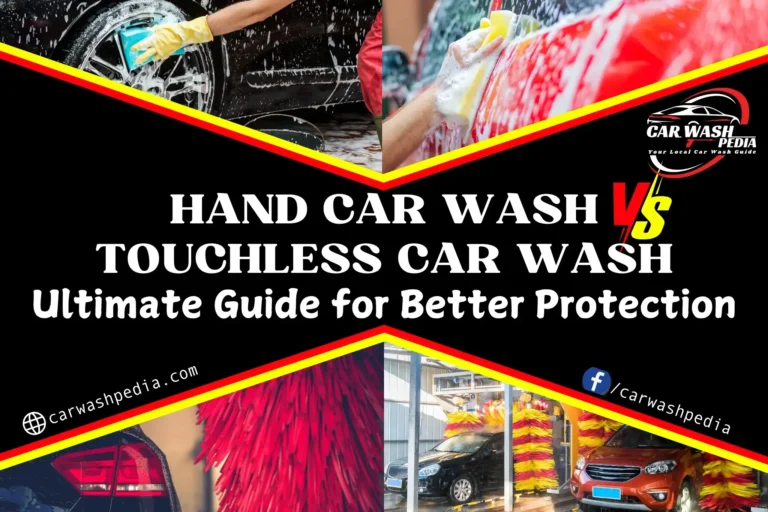
Hand Car Wash vs Automatic Car Wash: Which is Better to Protect Paint?
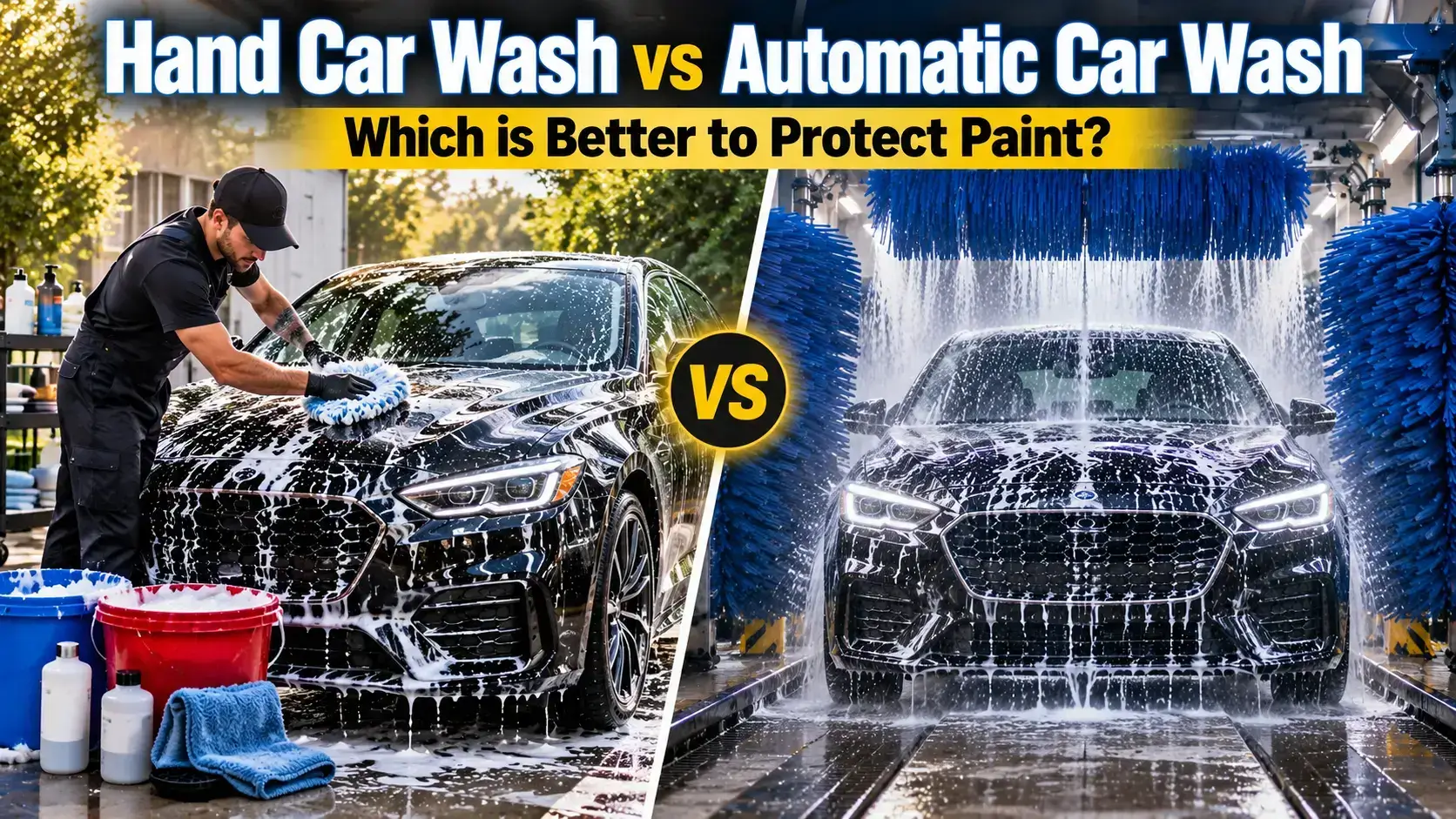
Plenty of drivers pull out of an automatic car wash and immediately wonder if they just traded a dirty car for a scratched one. Here is the honest answer. Modern soft-cloth and touchless automatic washes are generally safe for most vehicles, hand washing done correctly is safer still, and poor technique in either method is what actually causes the swirl marks and fine scratches people blame on the wrong culprit. This guide breaks down cost, time, paint safety, and environmental impact for both methods, by vehicle type and by what you actually care about, and you can run your own numbers through our free car wash cost calculator once you know which method fits your situation.
The Quick Answer
As a general rule, both hand washing and automatic car washing are safe for your paint when done correctly, and the method itself matters less than how well it is executed. The real qualifier comes down to three things:
- Which type of automatic wash you are using? A soft-cloth or touchless system is far gentler than an old hard-brush tunnel wash.
- What is currently on your paint? A ceramic coating or PPF changes, which method is actually recommended.
- How the hand wash is actually done? A rushed wash with a dirty sponge and one bucket can cause more damage than a well-maintained automatic wash ever would.
Not All Automatic Washes Are the Same
Most of the fear around automatic car washes traces back to one specific type of equipment, and lumping all automatic washes together is where a lot of bad advice comes from. Here is what actually separates them.
Soft-cloth (friction) washes
These use strips of soft cloth or dense foam material mounted on rotating arms that make light contact with the car alongside soap and water. Done right, on clean, well-maintained equipment, this is a gentle process, the material is designed to flex around the body panels rather than scrub against them. The real risk here is maintenance, not the method itself. Cloth strips that are not replaced or rinsed regularly accumulate grit from every car that passes through, and at that point, the equipment is functioning like a dirty wash mitt on a loop, dragging the same contaminants across every vehicle that follows. A well-run soft-cloth wash is safe for regular use, a poorly maintained one is not, and there is often no way to tell the difference from the outside except by watching how clean the cloth strips actually look before your car goes through.
Touchless washes
Touchless systems skip physical contact entirely, relying on high-pressure water jets and stronger detergents to break down and lift dirt off the surface. Zero physical contact means zero risk of the friction-based swirl marks that come from brushes or cloth. The trade-off is chemistry. Since there is no scrubbing to help loosen bonded grime, touchless washes lean on stronger cleaning agents to do that work instead, and those chemicals can wear down wax, sealant, or a maintenance-level ceramic spray faster with repeated use. Touchless washes also tend to struggle more with heavily bonded contaminants like baked-on bugs or tar, since there is nothing physically breaking that bond, only water pressure and chemical action.
Old hard-brush tunnel washes, increasingly rare but still worth flagging
This is the equipment most people are actually picturing when they picture damage, and it is largely responsible for the reputation automatic car washes still carry. Stiff nylon bristle brushes were the industry standard for decades, and they are considerably more abrasive than modern cloth or foam. Grit and dirt from previous vehicles get caught in the bristles and dragged across the next car’s paint, and this is also the equipment most associated with antenna snapping and mirror damage complaints. Most facilities have phased this equipment out in favor of softer materials, but it has not disappeared entirely, particularly at older or lower-cost locations. If a facility still uses visible hard bristle brushes rather than soft cloth strips, that is the one type of automatic wash worth being genuinely cautious about.
Side-by-Side Comparison
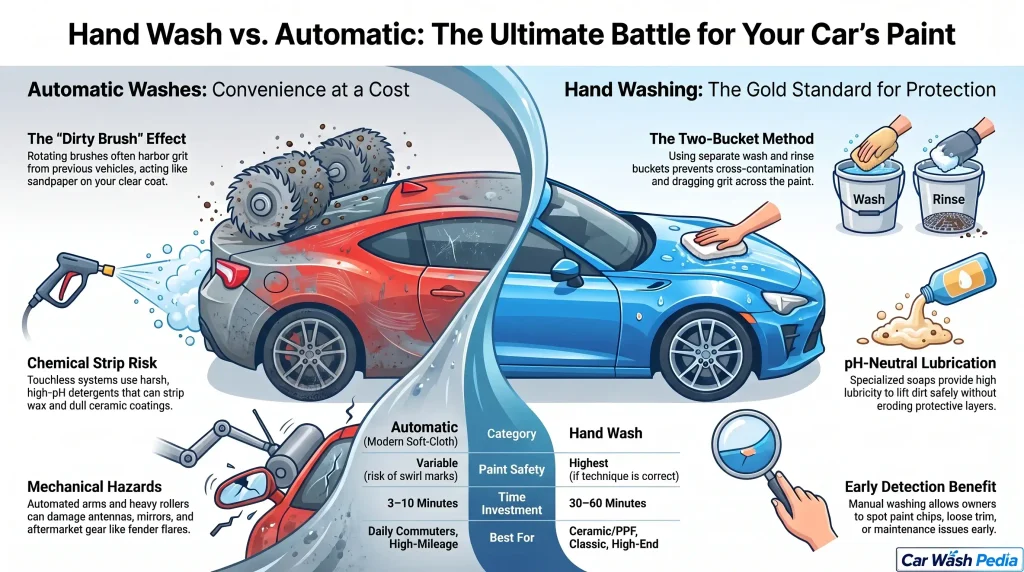
| Category | Hand Wash | Automatic Wash |
|---|---|---|
| Cost | Free to a few dollars per wash once you own basic supplies, higher upfront cost for soap, mitts, and towels | Typically $10-$30 per visit, or a flat monthly fee if you join a membership |
| Time | 30-60 minutes per wash, plus setup and cleanup | Usually 3-10 minutes total, most of that spent in line |
| Paint Safety | Safest option when done correctly with a two-bucket method and clean tools, high risk when done with a dirty sponge or single bucket | Safe on modern soft-cloth or touchless equipment in good condition, real risk on old hard-brush systems |
| Convenience | Requires driveway access, a water source, and your own time and effort | Drive through and go, no equipment to buy, store, or maintain |
| Environmental Impact | Soap and grime can run straight into storm drains unless washed on a permeable surface | Professional facilities typically reclaim and reuse a meaningful share of their wash water |
| Best For | Ceramic coated or PPF vehicles, classic cars, anyone prioritizing finish quality above all else | Daily commuters, high-mileage drivers, anyone prioritizing speed and convenience |
One clarification worth stating plainly, the Automatic Wash column above assumes a modern soft-cloth or touchless facility, the kind covered in the previous section. Swap in an old hard-brush tunnel wash, and the Paint Safety row shifts considerably in the other direction.
Which One You Should Choose, By Situation
The comparison above covers the general trade-offs. Here is how that plays out once you factor in your actual vehicle and circumstances.
| Situation | Best Fit | Why |
|---|---|---|
| Ceramic coated or PPF vehicle | Hand wash | Strong detergents used in many automatic washes, especially touchless systems, can wear down coatings and films faster than gentle hand washing with pH-neutral soap. |
| Daily commuter | Modern soft-cloth or touchless automatic wash | Frequent washing is necessary to manage road film and grime, and a quick automatic wash makes that realistic on a regular schedule without eating into your week. |
| Classic or collector car | Hand wash | Older paint and trim were not engineered for modern automatic wash equipment, and the low mileage on these vehicles usually makes the extra time worth it. |
| Work truck or fleet vehicle | Automatic wash | Speed and cost efficiency matter more than finish perfection on a vehicle that exists to work, not to be admired under direct light. |
| No driveway or water access | Automatic wash | Hand washing requires a legal, practical space to do it, apartment living or street parking without a hose removes that option entirely. |
| Budget-focused DIY owner | Hand wash | Once basic supplies are purchased, the cost per wash drops well below a paid automatic wash, and it stays that way for as long as you keep washing at home. |
| Leased vehicle | Hand wash, or a well-maintained modern automatic wash | Lease return inspections penalize swirl marks and paint damage, so consistency and gentleness matter more here than on a vehicle you plan to keep for years. |
Is an Automatic Car Wash Actually Bad for Your Car?
No, not automatically, and the qualifier matters more than the answer itself. A modern soft-cloth or touchless automatic wash, properly maintained, does not damage paint under normal use. The reputation automatic washes carry comes almost entirely from a different era of equipment, the stiff nylon bristle brushes that dominated the industry for decades and are still associated with snapped antennas, torn mirrors, and visible swirl marks under direct sunlight.
That equipment has largely been phased out, and most facilities built or renovated in the last several years use soft cloth strips or touchless systems instead. The fear has not caught up to the equipment. Plenty of drivers still avoid automatic washes entirely based on a reputation earned by machinery that has not been standard for years.
This does not mean every automatic wash today is automatically safe either. A soft-cloth facility running dirty, unrinsed cloth strips functions closer to the old reputation than the new one, and the equipment alone does not guarantee a safe wash, maintenance does. The honest takeaway is this. Ask what type of equipment a facility uses before assuming the worst, and judge the specific location rather than automatic car washes as a category.
How to Reduce Risk, Whichever Method You Choose
Whichever method fits your situation, a few specific habits make the difference between a safe wash and one that slowly damages the paint. This is the part most drivers skip past, and it matters more than the method itself.
What to look for in a good automatic wash
Look at the equipment before you commit to a location, not after a problem shows up. Soft cloth strips or a touchless system are what you want, visible stiff bristle brushes are the equipment to avoid entirely. On soft-cloth facilities, the cloth strips themselves are worth a glance, they should look reasonably clean, not matted with visible grime from previous vehicles. A facility that offers an under-body rinse is a genuine bonus, particularly in winter, since it clears road salt from areas a home hose rarely reaches effectively. Busy locations with high daily traffic tend to maintain their equipment more consistently than quiet, rarely used facilities, since worn cloth or brushes get noticed and replaced faster when more cars are going through every day.
What to avoid when hand washing
The mistakes here are the same ones covered in our full wash frequency guide, and they are worth repeating because they are exactly what causes the damage people wrongly blame on automatic washes instead. Skip the single bucket, reusing the same soapy water means dragging lifted dirt right back onto the paint on your next pass. Skip the dish soap, it strips wax and protective coatings along with the grime. Skip circular scrubbing motions, straight, back and forth passes spread contact more evenly and avoid the swirl pattern circles tend to leave behind, especially visible on dark paint. And skip air drying, water left to evaporate on its own leaves mineral spots that get mistaken for a separate problem entirely. The two-bucket method with clean microfiber mitts and towels remains the safest possible way to wash a car, but only when it is actually done that way, and not every hand wash is.
The Real Cost Comparison
Cost is rarely a fixed number for either method, since both hand washing and automatic washing shift in price based on where you live, what you drive, and how often you wash. Here is the honest range, along with what actually moves those numbers.
Hand washing carries a real upfront cost, soap, mitts, towels, and a couple of buckets, but that cost is spread across dozens of washes once purchased, bringing the effective cost per wash down to a few dollars at most. Automatic washing typically runs anywhere from 10 to 30 dollars per visit depending on the tier, or a flat monthly fee if you join an unlimited membership, which changes the math entirely once you wash more than a couple of times a month.
Neither of those ranges tells the full story on their own. Six factors move the needle most on what you will actually pay for either method.
- Your location. Since urban and coastal areas generally price higher than rural regions.
- Your vehicle size. Since trucks and full-size SUVs cost more to wash than compact cars and sedans, whether you are buying supplies sized for the vehicle or paying a size-based price at a facility.
- Your climate. Since snow, salt, humidity, and dust all change how often a wash is needed and how thorough that wash has to be.
- Any add-ons. Wax, ceramic spray or interior services, all add incrementally to the base price of either method.
- How often you wash. Since frequent washing is exactly what makes an unlimited membership dramatically cheaper per visit.
- Sales tax. This varies meaningfully by state or province and changes your final total either way.
Rather than guessing which method saves more based on national averages that may not reflect your situation, run your specific location, vehicle, and frequency through our free car wash cost calculator to see your actual break-even point between hand washing and an automatic wash membership.
The Environmental Side Nobody Talks About
Almost every article comparing these two methods stops at cost, time, and paint safety. There is a real environmental difference between them too, and it rarely comes up in the conversation.
Washing a car in a driveway sends the soap, dirt, oil residue, and grime straight into the nearest storm drain, along with whatever runs off the driveway itself. Storm drains are not connected to a treatment plant in most cities, they flow directly into local rivers, lakes, or coastal waters exactly as they are. That means detergent and the contaminants lifted off your car during a driveway wash typically enter local waterways untreated, which is why some municipalities restrict or actively discourage washing cars on driveways and streets, and why charity car washes are often required to use containment mats or wash on grass instead of pavement.
Professional car wash facilities operate under a different setup entirely. Most are connected to the sanitary sewer system rather than storm drains, meaning wastewater is treated before it re-enters the environment rather than flowing straight into it. Many facilities also reclaim and reuse a meaningful share of their wash water across multiple vehicles, cutting down on total water consumption per car compared to an untreated hose running the full length of a driveway wash.
This does not mean hand washing is off the table, plenty of people do it responsibly, using biodegradable soap and washing on grass or gravel where runoff soaks into the ground instead of reaching a drain. It does mean the environmental impact of where and how you hand wash is worth the same attention as the environmental impact of choosing between wash methods in the first place.
Frequently Asked Questions
1. Is automatic car wash bad for your car’s paint?
No, not automatically. A modern soft-cloth or touchless automatic wash, properly maintained, does not damage paint under normal use. The bad reputation traces back mostly to older hard-brush tunnel washes, which are increasingly rare but still worth checking for before choosing a location.
2. Are touchless car washes safer than soft-cloth washes?
Touchless washes eliminate the friction risk entirely since there is no physical contact with the paint, but they rely on stronger detergents to do the cleaning instead, which can wear down wax, sealant, or a maintenance-level coating faster with repeated use. Neither type is universally safer, touchless wins on friction risk, soft-cloth wins on being gentler on existing protection, when both are well maintained.
3. Can I use an automatic car wash on a ceramic coated car?
Occasionally, yes, without major concern, but hand washing is the better primary method for a coated vehicle. The stronger detergents used in many automatic washes, especially touchless systems, break down coatings faster than gentle hand washing with a pH-neutral soap does.
4. Is hand washing always safer than automatic car wash?
No, only when it is actually done correctly. A hand wash using a single bucket, a dirty sponge, or dish soap can cause more damage than a well-maintained modern automatic wash. The two-bucket method with clean tools is what makes hand washing the safer option, not the act of washing by hand itself.
5. Which is cheaper, hand washing or automatic car wash?
Hand washing is usually cheaper on a pure cost basis once you already own basic supplies, often working out to a few dollars per wash. An automatic wash typically costs 10 to 30 dollars per visit, though an unlimited membership can become cheaper than hand washing if you wash frequently enough.
6. Do automatic car washes damage antennas or mirrors?
This is mostly a legacy issue tied to old hard-brush tunnel washes, where stiff bristles could catch and snap a fixed antenna or fold back a mirror with too much force. Modern soft-cloth and touchless facilities rarely cause this kind of damage, though retracting or folding in mirrors before entering any automatic wash is still a reasonable habit.
7. How often can I safely use an automatic car wash?
As often as you need to, at a well-maintained, modern soft-cloth or touchless facility. Frequency itself is not the risk, the condition of the equipment and how well it is maintained matters far more than how many times your car goes through it.
The Bottom Line
There is no universal winner between hand washing and an automatic wash, despite what most articles on this topic try to argue. The right choice comes down to your specific vehicle, what is currently on the paint, and which of the priorities covered above, cost, time, paint safety, or environmental impact, matters most to you. Run your own numbers through our free car wash cost calculator to see which method actually saves you more, and explore our full Car Wash Tips hub for more honest, hands-on guides like this one.