How Often Should You Wash Your Car? A Real Answer for Every Situation

Type “how often should you wash your car” into Google, and you will get the same answer from almost every result: every two weeks. That sounds precise, but it is really just a shrug dressed up as advice, because a garage kept weekend car and a rideshare driver logging three hundred miles a day have nothing in common.
Here is the real answer. Most daily driven cars need a wash every one to two weeks, but your actual number depends on your climate, how you drive, where you park, and what protection is currently on your paint. Below, I will break that down by situation, so you land on a schedule built for your car, not a generic average pulled from a dozen other blogs.
The Quick Answer
For an average daily driven car, wash it every one to two weeks. That baseline covers a typical commuter who parks outside and drives mostly on paved roads. Your real number moves up or down from there based on three things: your climate, how and where you drive, and what is currently protecting your paint, whether that is bare paint, wax, sealant, or ceramic coating. A dusty desert commute, a salted winter road, or a bare hood with no protection all push that number lower. A garage kept weekend car with a fresh ceramic coating can stretch it out much further.
How Often to Wash Your Car, By Situation
Averages only get you so far. Here is how the schedule actually shifts once you plug in your real conditions.
| Situation | Recommended Frequency | Why |
|---|---|---|
| Daily city commuter | Every 1-2 weeks | Paved roads keep grime lighter, but exhaust film, dust, and bird droppings still build up fast with daily exposure. |
| Highway/long-distance daily driver | Every 1 week | Highway speeds drive bugs, tar, and road film into the paint and front end harder than city driving does. |
| Weekend/garage-kept car | Every 3-4 weeks | Minimal exposure to the elements means dirt accumulates slowly, and a garage protects the paint between washes. |
| Coastal or salt-air area | Every 1 week | Salt in the air settles on the paint and metal even without a single drive, and it accelerates corrosion if left sitting. |
| Winter road-salt states | Every 1 week, more after a snow event | Road salt is one of the fastest ways to eat through a clear coat and start rust on the undercarriage, rinsing it off matters more than the calendar does. |
| Dusty/desert climate | Every 1-2 weeks | Dry climates skip the mud, but fine dust is abrasive, and it scratches the paint every time you wipe it off dry instead of washing it. |
| Rideshare or delivery driver | Every few days to weekly | High daily mileage means constant exposure to road grime, plus interiors need attention just as often as the exterior does. |
| Ceramic coated vehicle | Every 1-2 weeks | Coatings make contaminants easier to remove, they do not stop dirt from landing on the paint in the first place. |
| Freshly corrected/new paint | Every 1-2 weeks, hand wash only | Fresh paint or a recent correction has no built-up layer of protection yet, so gentle, frequent hand washing matters more than usual until wax or coating goes on. |
What Actually Changes Your Number
The table above gives you a starting point. This section explains the mechanics behind each variable, so you can adjust the schedule as your situation changes throughout the year.
1. Climate and weather:
Heat and sun are harder on a wash schedule than most people expect. Hot climates bake dust and bird droppings onto the clear coat within hours, and direct sun during a wash dries soap before you can rinse it, leaving spots that look like water damage. Humid and wet climates create a different problem, since grime stays damp and sits against the paint longer instead of drying and blowing off. Cold climates bring the added issue of freeze-thaw cycles pushing road salt and moisture into every seam and wheel well, which is why winter washing matters more than the temperature alone suggests.
2. Where you park (garage vs. street vs. under trees):
A garage kept car skips most of what damages paint between washes, direct sun, bird droppings, sap, and airborne salt, so it can go longer between washes without much penalty. Street parked cars take the opposite path, picking up dust, exhaust residue, and whatever the weather brings, day after day. Parking under a tree feels shaded and convenient, but it is one of the worst habits for paint. Sap and bird droppings under a tree are both acidic, and they etch into a clear coat fast if left sitting more than a day or two.
3. Driving conditions (gravel, dirt roads, highway film vs. paved city)
Gravel and dirt roads kick up fine debris that pits paint on the lower panels and packs into wheel wells, where it holds moisture against the metal. Highway driving adds a different layer, bug splatter and tar film that bond to the front bumper and mirrors within a single trip and get harder to remove the longer they sit. Paved city driving is the gentlest of the three, but it is not clean, exhaust residue and brake dust from traffic still build a fine film over a week or two, even without a single off-road mile.
4. Paint color and finish (dark colors show dirt and swirls faster)
Dark colors, black especially, show every bit of dust, water spot, and swirl mark under direct light, which makes them look dirty faster even when they are not objectively dirtier than a lighter car. That visibility alone pushes most black and dark blue owners toward more frequent, gentler washing, since scrubbing at swirls only makes them worse. Matte finishes are a separate case entirely, they cannot be waxed, polished, or clay barred with standard products, so washing technique matters even more than frequency to avoid permanently altering the finish.
5. What’s protecting the paint (bare paint vs. wax vs. sealant vs. ceramic coating)
Bare paint has nothing between it and the environment, so contaminants bond directly to the clear coat and washing needs to happen on the more frequent end of your range. A coat of wax typically holds up for four to six weeks and adds a sacrificial layer that makes dirt easier to rinse off, though it does not reduce how often you should wash. Paint sealant extends that protection to around three to four months with similar benefits. Ceramic coating goes further, lasting anywhere from two to five years depending on the product, and makes contaminants sit on top of the surface instead of bonding to it, which is why coated cars still need regular washing, just with far less scrubbing effort.
Signs Your Car Needs a Wash Right Now
A schedule is a starting point, not a rule that overrides what your car is actually telling you. These signs mean it is time to wash regardless of where you are in your usual cycle.
1. Glare and reduced visibility through the glass:
A thin film on the windshield scatters headlights and sunlight, and most drivers blame their eyes or their wiper blades before they realize the glass itself is coated in grime. If oncoming headlights start looking like starbursts at night, check the windshield before anything else.
2. A gritty texture when you run a hand over the hood:
Clean paint feels smooth under your palm. If it feels like fine sandpaper instead, that is embedded dust and airborne contaminants sitting on the clear coat, and every mile you drive after that grinds them in a little deeper. This is one of the most reliable signs, and one almost nobody actually checks for.
3. Bird droppings or tree sap sitting for more than a day or two:
Both are acidic, and both start etching into clear coat well before they look like a serious problem. If you notice either on the paint, treat it as an immediate wash trigger, not something to handle on your next scheduled wash day.
4. Road film dulling the color:
A layer of exhaust residue, brake dust, or general road grime settles in gradually, so the color looks slightly flat or hazy rather than obviously dirty. This one is easy to miss because it happens slowly, the fix is to compare the hood or roof to a lower panel that gets less direct exposure, if there is a visible difference in shine, it is time to wash.
Can You Wash Your Car Too Often?
No, washing your car every day will not damage the paint by itself. Modern clear coats are far more durable than the ones used decades ago, and frequency alone is not what causes swirl marks or fine scratches. The real risk is technique, not how often you wash.
This is worth being direct about, because it is one of the most repeated myths in car care, and it usually gets left as an unanswered question header rather than an actual answer. Older paint systems from decades past were softer and more prone to hazing with frequent contact, which is likely where the myth started. Clear coats used today hold up fine to daily contact when the wash itself is done correctly.
What actually causes damage is washing with a dirty mitt, reusing the same wash water without a rinse bucket, using a towel that has picked up grit from a prior use, or drying with anything other than a clean, soft microfiber towel. Do any of those once a week, and you will see swirl marks build up just as fast as someone who does them daily. Wash correctly every single day, and the paint holds up fine.
So the honest answer is not “wash less,” it is “wash however often you need to, but treat the technique as seriously as the schedule.” A car washed daily with clean tools and a light touch will look better a year from now than one washed every two weeks with a dirty sponge and a garden hose.
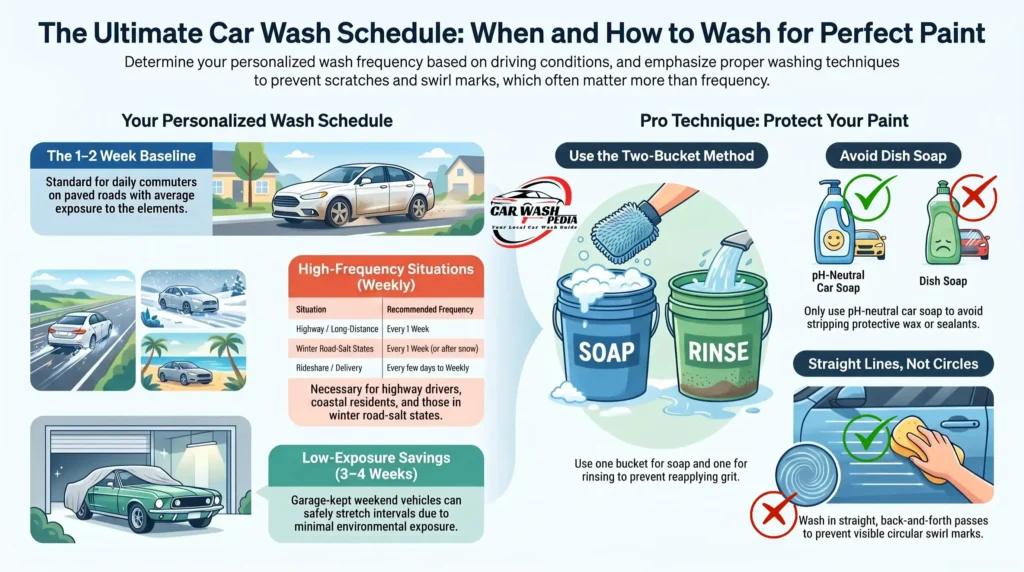
Frequency Is Not the Whole Story, Technique Matters Just as Much
You can follow the schedule above perfectly and still end up with a car covered in fine scratches if the washing itself is done wrong. This is the part almost every car care article skips entirely, and it matters more than the calendar does.
- Use the two-bucket method, not one. One bucket means you are dipping a dirty mitt back into the same soapy water you just used to lift dirt off the paint, which puts that same grit right back onto the surface on your next pass. Two buckets, one with soap and one with plain rinse water, plus a grit guard at the bottom of each, let you rinse the mitt clean before it touches the paint again. This single change prevents more swirl marks than almost anything else on this list.
- Keep your mitts and towels separated by job. A wheel mitt or brush that touches brake dust and road grime should never touch the body panels, and a towel used on the wheels should never dry the paint. Cross contamination between wheels and body is one of the most common ways people scratch paint they otherwise washed carefully. Keep at least three separate towels or mitts on hand, one for wheels, one for the body, one for glass or interior surfaces.
- Skip dish soap, use a pH-neutral car wash soap. Dish soap is built to cut grease, which also means it strips wax, sealant, and the protective layer on top of ceramic coatings. It leaves the paint more exposed to the elements right after a wash that was supposed to protect it. A pH-neutral car soap cleans just as effectively without breaking down whatever protection is already on the paint.
- Wash in straight lines, not circles. Circular motions concentrate whatever fine grit is on the mitt into a swirling pattern that becomes visible as light hits the paint at an angle, especially on dark colors. Straight, back and forth passes spread that same contact over a wider area and are far less likely to leave a visible pattern, even if a stray particle does cause a mark.
- Dry with a clean microfiber towel, do not let the car air dry. Air drying leaves mineral deposits from the water sitting on the surface, which harden into the water spots people often mistake for a separate problem. A drying aid sprayed on before wiping adds slip, so the towel glides instead of dragging any remaining particles across the paint. Blot large panels rather than wiping in tight circles, and switch to a fresh towel section as it gets damp instead of pushing a fully soaked towel across the whole car.
Frequency gets your car clean on schedule. Technique is what determines whether that same wash protects the paint or slowly damages it.
Full Wash vs. Maintenance Wash vs. Quick Detail Spray
Most people think washing a car means one thing, a full soap and water wash from start to finish. In practice, experienced detailers rotate between three different cadences, and knowing the difference lets you keep a car looking clean far more often than a full wash schedule alone would allow.
Full Two-Bucket Wash:
This is the complete process covered in the technique section above, soap, two buckets, dedicated mitts, proper drying. It is the only method that actually removes bonded contamination like road film, bug residue, and embedded dust. This is what your baseline schedule from the table earlier refers to, and it should stay the backbone of your routine regardless of what else you add around it.
Rinseless or Waterless Maintenance Wash:
This uses a concentrated wash solution mixed with water in a single bucket, applied with a mitt and wiped away with a microfiber towel, without a hose or running water at all. It is not a replacement for a full wash, but it is an effective way to keep light dust and surface grime off the car between full washes, especially for a garage kept car that only picks up a thin layer during the week. Many apartment dwellers and anyone without easy access to a hose rely on this method as their primary wash, and it works well as long as the car is not heavily soiled to begin with.
Quick Detail Spray:
This is the fastest of the three, a spray-on product wiped off with a clean microfiber towel, meant for spot contamination rather than a full clean. Bird droppings, a few water spots, light dust from a car cover, or pollen sitting on the hood are all situations where a quick detail spray handles the problem in minutes without a full wash session. It should never be used to remove heavy dirt or grit, since wiping abrasive particles with a spray and towel is a fast way to create the swirl marks the technique section just covered.
Used together, these three methods let a full wash happen every one to two weeks as the table recommends, while a rinseless wash or quick detail spray handles anything that shows up in between. That combination keeps the paint looking consistently clean without turning every noticeable spot into an unplanned full wash session.
Does Rain Actually Wash Your Car?
No, rain does not wash your car. It often makes it look dirtier once it dries.
Rain picks up dust, pollen, and airborne pollutants on the way down, then deposits them directly onto the paint instead of rinsing them off. Without a towel to dry the surface immediately after, that water evaporates on its own and leaves mineral deposits and whatever contaminants it was carrying behind as spots. This is especially noticeable on dark paint, where dried rain spots show up as a hazy, speckled film across the hood and roof.
A real wash rinses contaminants away and dries the surface before anything has a chance to sit and harden. Rain does the opposite, it adds contaminants and leaves them to dry in place. If your car gets caught in a storm, treat it the same as any other contamination, plan a wash rather than assuming the weather did the job for you.
Seasonal Adjustments for US Car Owners
The schedule and factors covered so far shift throughout the year, since every season brings a different type of contamination. A quick season-by-season adjustment keeps you ahead of it instead of reacting after the damage is already done.
Winter:
Road salt is the single biggest threat to paint and the undercarriage during the colder months, and it does its damage quietly, working into seams and wheel wells long before rust becomes visible. Wash weekly at minimum during salt season, and more often right after a snowstorm once roads have been treated. Our full winter car wash guide covers cold weather technique in more detail, including how to avoid frozen door seals and locks.
Spring:
Pollen is the defining problem this time of year, a fine yellow or green film that settles on every horizontal surface within a day of a car sitting outside, and it is acidic enough to etch into a clear coat if it sits for a week or more. A quick detail spray between full washes handles light pollen well, see our spring car wash tips for the full seasonal routine.
Summer:
Heat and direct sun turn ordinary washing into a bigger challenge, since soap and water can dry on the paint before you finish rinsing, leaving spots that look like a failed wash. Bug splatter also builds up fast on the front bumper and mirrors during long summer drives and hardens within hours if left untouched. Wash in the shade or during early morning or evening hours, and check our summer car wash tips for heat specific technique.
Fall:
Falling leaves and acorns bring tree sap and organic staining that acts the same way bird droppings do, acidic and fast to etch if ignored. Cars parked under trees during this season need more frequent checks than the general schedule suggests, even if the car does not look obviously dirty yet.
Washing vs. Waxing vs. Full Detailing, How Often for Each
Washing, waxing, and detailing get lumped together as one topic, but they run on completely different schedules and solve different problems. Here is how the three actually break down.
| Task | Frequency | What It Does |
|---|---|---|
| Washing | Every 1-2 weeks | Removes surface dirt, grime, and contaminants before they bond to the paint |
| Wax or paint sealant | Every 2-3 months | Rebuilds the sacrificial protective layer that washing gradually strips away |
| Ceramic coating maintenance wash | Every 1-2 weeks | Keeps the coated surface free of contaminants so the hydrophobic layer keeps performing |
| Full detail | Every 6-12 months | Deep cleans, corrects minor imperfections, and resets the paint and interior to a like-new baseline |
Washing is the routine maintenance that has to happen on a short cycle regardless of anything else, it is covered in full in our DIY car wash guide if you want the complete step-by-step process.
Wax and sealant sit on top of that clean paint as a sacrificial barrier, and washing slowly wears that layer down over weeks, which is why reapplying every two to three months keeps the protection active instead of leaving bare paint exposed without you realizing it.
Ceramic coating changes this equation. It does not need reapplying every few months like wax, a properly applied coating lasts years, but it still requires the same one to two week wash cycle as bare or waxed paint, since the coating repels contaminants, it does not stop them from landing on the surface in the first place. Our ceramic coating guide covers application, cost, and realistic expectations if you are deciding whether it is worth it for your car.
A full detail is the reset point behind all of it, correcting whatever washing and waxing alone could not fix, from minor swirl marks to interior buildup that a weekly wash never touches. Once or twice a year is enough for most daily drivers, more often only makes sense for show cars or vehicles under heavy daily use.
What This Actually Costs You Per Month
A wash schedule is not just a paint care decision, it is also a monthly cost most people never actually calculate. Washing every one to two weeks looks different on your wallet depending on whether you wash at home or pay for it.
Washing at home has a real cost too, even though it feels free. Soap, mitts, towels, a bucket setup, and an occasional drying aid all wear out and need replacing, and that cost is easy to underestimate when you are only thinking about the price of one bottle of soap. Spread across a year, a decent home setup usually still comes out cheaper than paying for every wash, but it is not zero.
Commercial car washes charge per visit or through a monthly membership, and the math changes significantly depending on which one you choose. A single pay-per-wash visit costs more per wash than a membership does once you are washing weekly or every other week, since memberships are built around frequent use. Someone washing twice a month usually breaks even or loses money on a membership built for weekly customers, while someone washing weekly almost always comes out ahead with a membership instead of paying per visit.
The right answer depends entirely on your actual frequency from the table earlier in this guide, not a guess. Run your numbers through our cost calculators to compare home washing, pay-per-visit, and membership costs side by side based on how often you actually wash, so you are working from real numbers instead of assuming one option is cheaper.
Frequently Asked Questions (FAQs)
Is it bad to wash your car every day?
No, not by itself. Modern clear coats hold up fine to daily contact, and frequency alone does not cause scratches or swirl marks. The real risk comes from technique, a dirty mitt, one bucket washing, or a towel that has picked up grit causes damage regardless of how often you wash.
How often should you wash a ceramic coated car?
Every one to two weeks, the same range as bare or waxed paint. A ceramic coating makes contaminants easier to rinse off, it does not stop dirt, pollen, or road grime from landing on the surface in the first place.
How often should you wax your car?
Every two to three months for wax or paint sealant. Regular washing gradually strips that protective layer, so reapplying on this cycle keeps the paint protected instead of quietly going bare without you noticing.
Does rain clean your car?
No. Rain deposits dust, pollen, and airborne pollutants onto the paint rather than rinsing them off, and without a towel to dry the surface right after, that water evaporates and leaves spots behind. Treat a car caught in the rain the same as any other contamination and plan a real wash.
Is touchless car wash safe for frequent washing?
Yes, in general. Touchless washes rely on high pressure water and stronger detergents instead of physical contact, which removes the swirl mark risk that comes from brushes or dirty mitts. The tradeoff is that the stronger chemicals used can wear down wax or sealant faster with frequent use, so alternating with a gentle hand wash works well for cars washed often.
How often should you wash your car in winter?
At least once a week during salt season, and sooner after any snowstorm once roads have been treated. Road salt works into seams and wheel wells quickly, and it causes far more long-term damage than a few days of visible dirt on the surface.
Can washing your car too much damage the paint?
Only if the technique is wrong. Washing daily with clean tools, a two bucket method, and proper drying is safe for the paint. Washing once a week with a dirty sponge and no rinse bucket causes damage regardless of how infrequent it is.
How often should you get a full detail vs. just a wash?
Wash every one to two weeks as routine maintenance, and schedule a full detail every six to twelve months. A wash removes surface dirt and grime, while a full detail corrects minor imperfections and resets both the paint and interior to a like-new baseline that a weekly wash alone cannot achieve.
The Bottom Line
There is no single universal number that fits every car, and anyone telling you a flat “every two weeks” without asking about your climate, your driving, or what is on your paint is giving you half an answer. Use the table and the factors above to set a real schedule for your car, then adjust it as the seasons change and stay alert to what your paint is actually telling you between washes. For more hands-on guides like this one, explore our full Car Wash Tips hub.